I) "Yoko Ono's Art of Defiance," Louis Menand (June 20, 2022). "Before she met John Lennon, she was a significant figure in avant-garde circles and had created a masterpiece of conceptual art. Did celebrity deprive her of her due as an artist?"
II) "A Hamlet for Our Time," Rebecca Mead (June 13, 2022): "In the play, the Prince’s dead father reappears as a ghost, but Lawther and Icke were contending with ghosts of their own: the accumulated legacies of performers, directors, critics, and other interpreters who have played Hamlet, or seen 'Hamlet.' In other words: How not to be Hamlet?"
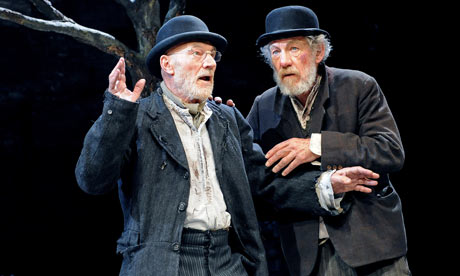
Patrick Stewart as Vladimir and Ian McKellan as Estragon in a recent production
To read the text of Waiting for Godot, click here.
Click here to watch Waiting for Godot with Barry McGovern and Johnny Murphy directed by Michael Lindsay-Hogg as part of the Beckett on Film series (with Turkish subtitles!).
Click here to hear Patrick Stewart, Ian McKellan, Ronald Pickup and Simon Callow discuss the challenges and the rewards of performing the play. "It's the hardest thing I have ever done," Patrick Stewart says. Click here for "The Chinese Restaurant" episode of Seinfeld. Click here for the script to that episode.
Click here for Waiting for Elmo, quite possibly the greatest Monsterpiece Theater ever. (I) THE ABSURD
(i) From M. H. Abrams' A Glossary of Literary Terms:
Literature of the Absurd or Theater of the Absurd: The term is applied to a number of works in drama and prose fiction which have in common the sense that the human condition is essentially absurd, and that this condition can be adequately represented only in works of literature that are themselves absurd. Both the mood and dramaturgy were anticipated as early as 1896 in Alfred Jarry's French play Ubu roi(Ubu the King). The literature has its roots also in the movements of expressionism and surrealism, as well as in the fiction, written in the 1920s, of Franz Kafka (The Trial, Metamorphosis). The current movement, however, emerged in France after the horrors of World War II, as a rebellion against essential beliefs and values of traditional culture and traditional literature. This earlier tradition had included the assumptions that human beings are fairly rational creatures who live in an at least partially intelligible universe, that they are part of an ordered social structure, and that they may be capable of heroism and dignity even in defeat. After the 1940s, however, there was a widespread tendency, especially prominent in the existential philosophy of men of letters such as Jean-Paul Sartre and Albert Camus, to view a human being as an isolated existent who is cast into an alien universe, to conceive the universe are possessing no inherent truth, value, or meaning, and to represent human life -- in its fruitless search for purpose and meaning, as it moves from the nothingness whence it came toward the nothingness where it must end -- as an existence which is both anguished and absurd. As Camus said in The Myth of Sisyphus (1942),
"In a universe that is suddenly deprived of illusions and of light, man feels a stranger. His is an irremediable exile . . . This divorce between man and his life, the actor and his setting, truly constitutes the feeling of Absurdity."
Or as Eugene Ionesco, French author of The Bald Soprano (1949), The Lesson (1951), and other plays in the theater of the absurd, has put it: "Cut off from his religious, metaphysical, and transcendental roots, man is lost; all his actions become senseless, absurd, useless." Ionesco also said, in commenting on the mixture of moods in the literature of the absurd: "People drowning in meaninglessness can only be grotesque, their sufferings can only appear tragic by derision."
Samuel Beckett (1906-89), the most eminent and influential writer in this mode, both in drama and in prose fiction, was an Irishman living in Paris who often wrote in French and then translated his works in English. His plays, such as Waiting for Godot (1954) and Endgame(1958), project the irrationalism, helplessness, and absurdity of life in dramatic forms that reject realistic settings, logical reasoning, or a coherently evolving plot. Waiting for Godot presents two tramps in a waste place, fruitlessly and all but hopelessly waiting for an unidentified person, Godot, who may or may not exist and with whom they sometimes think they remember that they may have an appointment; as one of them remarks, "Nothing happens, nobody comes, nobody goes, it's awful." Like most works in this mode, the play is absurd in the double sense that it is grotesquely comic and also irrational and nonconsequential; it is a parody not only of the traditional assumptions of Western culture, but of the conventions and generic forms of traditional drama, and even of its own inescapable participation in the dramatic medium. The lucid but eddying and pointless dialogue is often funny, and pratfalls and other modes of slapstick are used to project the alienation and tragic anguish of human existence. Beckett's prose fiction, such as Malone Dies (1958) and The Unnameable (1960), present an antihero who plays out the absurd moves of the end game of civilization in a nonwork which tends to undermine the coherence of its medium, language itself. But typically Beckett's characters carry on, even if in a life without purpose, trying to make sense of the senseless and to communicate the uncommunicable.
Another French playwright of the absurd was Jean Genet (who combined absurdism and diabolism); some of the early dramatic works of the Englishman Harold Pinter and the American Edward Albee are in a similar mode. The plays of Tom Stoppard, such as Rosencrantz and Guildenstern Are Dead (1966) and Travesties (1974), exploit the devices of absurdist theater more for comic than philosophical ends. There are also affinities with this movement in the numerous recent works which exploit black comedy or black humor: baleful, naive, or inept characters in a fantastic or nightmarish modern world play out their roles in what Ionesco called a "tragic farce," in which the events are often simultaneously comic, horrifying, and absurd. Examples are Joseph Heller's Catch-22 (1961), Thomas Pynchon's V (1963), John Irving's The World According to Garp (1978), and some of the novels by the German Gunter Grass and the Americans Kurt Vonnegut, Jr., and John Barth. Stanley Kubrick's Dr. Strangelove is an example of black comedy in the cinema. More recently, some playwrights living in totalitarian regimes have used absurdist techniques to register social and political protest. See, for example, Largo Desolato (1987) by the Czech Vaclav Havel and The Island (1973), a collaboration by the South African writers Athol Fugard, John Kani, and Winston Ntshona.
(ii) From J. A. Cuddon's Penguin Dictionary of Literary Terms and Literary Theory:
The theatre of the absurd -- Camus in particular, but the movement in general -- "expounded in some detail a vision of life which was essentially absurd, without apparent purpose, out of harmony with its surroundings, sad to the point of anguish, and at the same time, in a laconic fashion, funny. [It] stresses the destructive nature of time, the feeling of solitude in a hostile world, the sense of isolation from other human beings."
(II) EXISTENTIALISM
Philosopher and writer Jean-Paul Sartre, from "L'existentialisme est un humanisme," a lecture delivered in Paris in 1946 (the complete text of the lecture, translated into English, is here):
"What is meant here by saying that existence precedes essence? It means that first of all, man exists, turns up, appears on the scene, and only afterwards defines himself [. . .]. Thus there is no human nature, since there is no God to conceive it [. . .]. Man is nothing else but what he makes of himself. Such is the first principle of existentialism. But if existence really does precede essence, man is responsible for what he is."
(III) ART AND THE PLANE OF THE FEASIBLE
In Beckett's Three Dialogues (1949), two characters, "D." and "B." hold a theoretical discussion regarding art and feasibility, art and what they call "the plane of the feasible":
D. What other plane can their be for the maker?
B. Logically, none. Yet I speak of an art turning from it in disgust, weary of its puny exploits, weary of pretending to be able of doing a little better the same old thing, of going a little further along a dreary road.
D. And preferring what?
B. The expression that there is nothing to express, nothing with which to express, nothing from which to express, no power to express, no desire to express, together with the obligation to express.
D. But that is a violently extreme and personal point of view, of no help to us in the matter.
B. - - - - - - - - -.
D. Perhaps that is enough for today.
(IV) BECKETT ON HABIT From Beckett's Proust (1931):
"Habit is the ballast that chains the dog to his vomit. Breathing is habit. Life is habit. Rarely does one experience the moment when the boredom of living is replaced with the suffering of being."
(V) HAYDEN WHITE ON LIVING
Historian Hayden White, from "The Modernist Event" (1996):
"Nothing happens while you live. The scenery changes, people come and go out, that's all. There are no beginnings. Days are tacked on to days without rhyme or reason, an interminable, monotonous addition . . . That's living."
Although guitar-driven music is still in many ways alive and well in a variety of genres and sub-genres, the dominant commercial forms of popular music in recent years—the kind of pop, dance, and hip-hop music we're most likely to hear when we're not even trying to hear music—fall, broadly speaking, under the heading of electronic music: music made with synthesizers, drum machines, or, more often than not, software emulations of either (or both). As part of our ongoing examination of the avant-garde and the mainstream, let's trace a couple of features of mainstream pop music back to their avant-garde/experimental/underground roots, before looking briefly at the avant-garde roots of electronic music on the whole. (I) From Bristol to Britney and Beyond: Dubstep In the early years of the '00s, a new genre of UK dance music began to take shape out of dub, a particularly bass-heavy reggae subgenre, and the shuffling rhythms of two-step garage. A prototypical early example is "Gorgon Sound" by Horsepower Productions (2002). A characteristic feature of dubstep is its distinctive approach to bass, which we hear in the above track at about 1:25. Technically, the effect is produced by modulating a particular parameter of the sound, the filter cutoff, with a low-frequency oscillator synced to the tempo of the piece. This sound has understandably become known as "wobble bass." As dubstep slowly grew throughout the decade, wobble bass and the "bass drop" took on an increasingly prominent role, and became, to many, the defining features of the genre. Joker's "Tron" (2010) is an excellent later example of dubstep that positions the genre's trademark wobble bass very much in the foreground (bass drop at 0:55). Much to the chagrin of what we might call dubstep purists, these characteristic features of the genre -- wobble bass and the bass drop -- would in time be be adopted by the makers of mainstream, radio-friendly pop. Britney Spears' "Hold it Against Me," produced by pop mainstays Max Martin and Dr. Luke, led to no small amount of outrage and finger-pointing in certain dark corners of the internet upon its early 2011 release (bass drop at 2:10).
These same features of dubstep taken up by Britney would soon thereafter go truly global, as we hear in Korean pop star Hyuna's "Bubble Pop," released in the summer of 2011 (bass drop at 2:20). American dubstep producer Skrillex (Sonny John Moore)—who, in 2012, was nominated for five Grammy awards and won three, a clear signal of mainstream acceptance -- has spoken about the relationship between avant-garde/experimental/underground electronic music culture and the mainstream. "The more the stuff that is underground becomes mainstream, the more the underground is gonna change," Skrillex said in an MTV interview. "I think it's gonna inspire people to obviously do something different." Commenting specifically on Britney Spears' "Hold it Against Me," Skrillex said: "I thought the dubstep part was unnecessary. Not to say it was done wrong. I feel like it was very self-aware and consciously put in there to be 'the dubstep part.' I can see a lot of people getting pissed about it — the purist dubstep and drum and bass fans — but at the end of the day, it's cool that people are trying new things. Sooner or later, anything that happens in the underground — be it watered down or not — it always makes itself into the mainstream. It's cool to hear." Interestingly, on the whole, Skrillex praised the song: "I thought the track was great overall. I'll be honest, man: I love Max Martin. I think he's an absolute genius. And Dr. Luke did it, right? I think they are a fucking dream team. I love the track!"
Skrillex, not to be mistaken for Sarah Gilbert in the rôle of Darlene Connor on the Roseanne series—recall Roseanne Barr on Seinfeld and Beckett!
In the years since, dubstep has become ubiquitous, a sound so thoroughly part of the mainstream, that it is used to sell Weetabix and Nerds (among many, many other things).
(II) From Lo-bat to Lisa Simpson: Chiptune Chiptune began as an obscure subgenre of electronic music in which artists coaxed sound and rhythm out of the 8-bit sound chips of obsolete computers and video game consoles, resulting in deliberately lo-fi, glitchy music that recalls the rudimentary video game soundtracks of thirty (or more) years ago. Lo-bat's "Tizzy" (2004) is a prime example of the genre, in which we hear an artist working with the notoriously difficult Nintendo Game Boy sound chip to produce blips and bleeps that initially sound almost random before they cohere. These sounds attracted the attention of other experimental electronic musicians, some of whom sampled liberally from these tracks released under non-commercial Creative Commons licences. Crystal Castles, a Toronto duo that achieved considerable critical acclaim in the UK (and some in North America), came under fire from the small but devoted chiptune community when the band used elements of compositions by Lo-bat (and others) and failed to credit or acknowledge their sources. One song that came under particular scrutiny is Crystal Castles' "Alice Practice" (2006), which in 2011 appeared high on NME's list of the best songs of the previous fifteen years. Crystal Castles were themselves allegedly sampled but not credited by hip-hop producer Timbaland, whose "Ayo Technology" (2007) with 50 Cent and Justin Timberlake bares a striking resemblance to Crystal Castle's "Courtship Dating." But regardless of who was sampling whom, properly or improperly, chiptune music was no longer an obscure, technical curiosity; it was, instead, a vital part of a top-five 50 Cent/Justin Timberlake single. At the same time, technological innovation meant that the sounds that had formerly been all but inaccessible to the non-specialist became comparatively easy to manipulate. (Despite this mainstream success, chiptune nevertheless retained its underground appeal through the end of the decade, as we hear evidenced in Joker's chiptune-influenced "Digidesign" [2009]).
Chiptune would reach its broadest audience to date a year later, when Kesha's "TiK ToK," co-written with and produced by Benny Blanco and Dr. Luke (again), would become the best selling single of 2010, with nearly thirteen million songs sold internationally in an era where sales figures only scratch the surface of a song's true presence in the culture. A comparatively slight six million people were exposed to "TiK ToK"—and thus to sounds that had been the exclusive domain of the avant-garde less than a decade before—when The Simpsonsreplaced their entire opening with a performance of the song. (III) The Popular Synthesis of Chiptune and Dubstep: Flo Rida's "Good Feeling" (2012) (produced by Cirkut and Dr. Luke) Subgeneric worlds collide at 2:45:
(IV) "The Reason Music Sounds Like It Does Today": Kraftwerk, Stockhausen, Schaeffer All modern electronic music—be it pop, house, techno, trance, IDM, hip hop, everything—is deeply indebted to the pioneering German group Kraftwerk, whose avant-garde experiments in the early 1970s gradually cohered into the conceptual "techno pop" they have performed in the decades since. "The Robots" (1978) is perhaps their signature piece.
Kraftwerk drew inspiration from Karlheinz Stockhausen's earlier experiments with electronic sound generation and tape manipulation, such as "Studie II (Electronik Musiche)" (1954) and his enormously influential "Gesang der Jünglinge" (1956). Stockhausen's work in turn descends from that of Pierre Schaeffer, the central figure in the avant-garde school of musique concrète, in which the artist records sounds as he or she finds them in the world, and manipulates them, sometimes minimally, to produce a composition. A notable example is Schaeffer's "Etude aux chemin de fer" (1948).
V) Everybody in the Place by Jeremy Deller, Sisters with Transistors by Lisa Rovner
Jeremy Deller's Everybody in the Place is a truly lovely lecture delivered to a London high school class that touches on all of the processes outlined in this post—the archival footage is to be treasured!
From the promotional materials: "[. . .] the new film written and directed by Jeremy Deller, explores the social history of the UK between 1985 and 1993 through the lens of acid house and rave music. The film is based on a real-life lecture given to a class of students in London."
Lisa Rovner's excellent 2020 documentary Sisters with Transistors takes us further back: it offers "the remarkable untold story of electronic music’s female pioneers, composers who embraced machines and their liberating technologies to utterly transform how we produce and listen to music today. The film maps a new history of electronic music through the visionary women whose radical experimentations with machines redefined the boundaries of music, including Clara Rockmore, Daphne Oram, Bebe Barron, Pauline Oliveros, Delia Derbyshire, Maryanne Amacher, Eliane Radigue, Suzanne Ciani, and Laurie Spiegel." (from the film's website)
(VI) Another Intersection Between Popular Music and The Avant-Garde
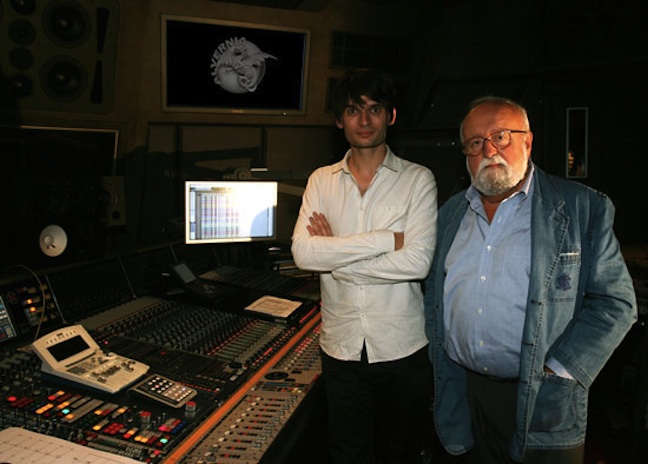
In 2011, both the electronic artist Richard D. James (who often performs as Aphex Twin) and Radiohead guitarist and composer Jonny Greenwood performed arrangements of the great Polish avant-garde composer Krzysztof Penderecki's "Threnody for the Victims of Hiroshima" and "Polymorphia" as part of the European Cultural Congress in Wroclaw. Penderecki himself was on hand for the performances. Read about the event here. Aphex Twin's performance is here.
(VII) BREAKING NEWS: There is something called "seapunk," and you have never heard of it, and it is already over
1) "In the Water," Beat Connection (2010). Writing at Pitchfork, Larry Fitzmaurice describes the song this way: "The boys are singing about being in the water, and their vocals sound dripping wet, as every elided syllable glistens under light."
(X) Not Even Your Food is Safe: "Toward a Theory of Normcore Food" Johannah King-Slutzky's "Toward a Theory of Normcore Food" (The Awl, 2015) is the finest piece of criticism conceivable on its subject. She writes:
"Small-batch pickles, Greek yogurt, and quinoa are all high-stakes trendy foods with loads of moral and aesthetic baggage. We ingest them to prove to ourselves that we are ethical by way of being health-conscious, multicultural, hard workers. Of course, the labor required to produce and consume a pickle won’t have any measurable effect on the health of your body, the quality of your soul, or the degree of your authenticity. This constellation of foods, which might be crudely labeled 'hipster food,' are the means by which our sense of goodness is outsourced through our gut.
"The antithetical culinary trend of hipster food, snackwave, seizes on its puritanism and refutes it through slovenliness, shopping mall imagery, and pro-capitalist branding. It is the first prong in the anti-hipster food backlash. As Hazel Cills and Gabrielle Noone write in The Hairpin, snackwave 'trickled up from Tumblr dashboards' to counter 'Pinterest-worthy twee cupcake recipes.' It is chiefly defined by excessive consumption of junk food and is often couched in the doctrine that women, especially, can do whatever they want to their bodies. An important element of snackwave is its individualism: the meal is communal, the snack is individual."
And:
"Normcore food is all of the following:
1. Ugly 2. Homemade but not artisanal 3. Would have been popular in the early nineties without becoming a nostalgia fetish item 4. Healthy but not cleansing 5. Can be made or purchased in batches large enough for a family but is usually eaten alone 6. Might use ethnic ingredients, but never in order to claim authenticity
Like snackwave, normcore food takes its cues from the internet."
And crucially:
"These principles don’t just make dialectical sense; they also reproduce normcore fashion’s source texts. Although normcore’s boundaries are contested, one premise about normcore fashion has remained universally unchallenged: Jerry and George would have worn it on Seinfeld. The question that naturally follows is, What would Jerry Seinfeld and George Costanza have eaten?"
ask Google Image Search what it knows about "postmodernism" and these are among the things it tells you
1. From “Modernism and Postmodernism,” in M. H. Abrams’ A Glossary of Literary Terms: The term modernism is widely used to identify new and distinctive features in the subjects, forms, concepts, and styles of literature and the other arts in the early decades of the present century, but especially after World War I (1914-1918). The specific features signified by “modernist” vary with the user, but many critics agree that it involves a deliberate and radical break with some of the traditional bases not only of Western art, but of Western culture in general. Important intellectual precursors of modernism, in this sense, are thinkers who had questioned the certainties that had supported traditional modes of social organization, religion, morality, and also traditional ways of conceiving the human self – thinkers such as Friedrich Nietzsche (1844-1900), Karl Marx, Sigmund Freud [. . .].
Literary historians locate the beginning of the modernist revolt as far back as the 1890s, but most agree that what is called high modernism, marked by an unexampled range and rapidity of change, came after the first World War. The year 1922 alone was signalized by the simultaneous appearance of such monuments of modernist innovation as James Joyce’s Ulysses, T. S. Eliot’s The Waste Land, and Virginia Woolf’s Jacob’s Room, as well as many other experimental works of literature. The catastrophe of the war had shaken faith in the moral basis, coherence, and durability of Western civilization and raised doubts about the adequacy of traditional literary modes to represent the harsh and dissonant realities of the postwar world. T. S. Eliot wrote in a review of Joyce’s Ulysses in 1923 that the inherited mode of ordering a literary work, which assumed a relatively coherent and stable social order, could not accord with “the immense panorama of futility and anarchy which is contemporary history.” Like Joyce and like Ezra Pound in his Cantos, Eliot experimented with new forms and a new style that would render contemporary disorder, often contrasting it to a lost order and integration that had been based on the religion and myths of the cultural past. In The Waste Land (1922), for example, Eliot replaced the standard syntactic flow of poetic language by fragmented utterances, and substituted for the traditional coherence of poetic structure a deliberate dislocation of parts, in which very diverse components are related by connections that are left to the reader to discover, or invent. Major works of modernist fiction, following Joyce’s Ulysses (1922) and his even more radical Finnegans Wake(1939), subvert the basic conventions of earlier prose fiction by breaking up the narrative continuity, departing from the standard ways of representing characters, and violating the traditional syntax and coherence of narrative language by the use of stream of consciousness and other innovative modes of narration. Gertrude Stein – often linked with Joyce, Pound, Eliot, and Woolf as a trail-blazing modernist–experimented with automatic writing (writing that has been freed from control by the conscious, purposive mind) and other modes that achieved their effects by violating the norms of standard English syntax and sentence structure. Among other European and American writers who are central representatives of modernism are the novelists Marcel Proust, Thomas Mann, André Gide, Franz Kafka, Dorothy Richardson, and William Faulkner; the poets Stéphane Mallarmé, William Butler Yeats, Rainier Maria Rilke, Marianne Moore, William Carlos Williams, and Wallace Stevens; and the dramatists August Strindberg, Luigi Pirandello, Eugene O’Neill, and Bertolt Brecht. Their new forms of literary construction and rendering had obvious parallels in the violation of representational conventions in the artistic movements of expressionism and surrealism, in the modernist paintings and sculpture of Cubism, Futurism, and Abstract Expression, and in the violations of standard conventions of melody, harmony, and rhythm by the modernist musical composers Stravinsky, Schoenberg, and their radical followers.
A prominent feature of modernism is the phenomenon called the avant-garde (a military metaphor: “advance-guard”); that is, a small, self-conscious group of artists and authors who deliberately undertake in Ezra Pound’s phrase, to “make it new.” By violating the accepted conventions and proprieties, not only of art but of social discourse, they set out to create ever-new artistic forms and styles and to introduce hitherto neglected, and sometimes forbidden, subject matter. Frequently, avant-garde artists represent themselves as “alienated” from the established order, against which they assert their own autonomy; a prominent aim is to shock the sensibilities of the conventional reader and to challenge the norms and pieties of the dominant bourgeois culture. [. . . .]
The term postmodernism is often applied to the literature and art after World War II (1939-1945), when the effects on Western morale of the first war were greatly exacerbated by the experience of Nazi totalitarianism and mass extermination, the threat of total destruction by the atomic bomb, the progressive devastation of the natural environment, and the ominous fact of overpopulation. Postmodernism involves not only a continuation, sometimes carried to an extreme, of the countertraditional experiments of modernism, but also diverse attempts to break away from modernist forms which had, inevitably, become in their turn conventional, as well as to overthrow the elitism of modernist “high art” by recourse to the models of “mass culture” in film, television, newspaper cartoons, and popular music. Many of the works of postmodern literature – by Jorge Luis Borges, Samuel Beckett, Vladimir Nabokov, Thomas Pynchon, Roland Barthes, and many others – so blend literary genres, cultural and stylistic levels, the serious and the playful, that they resist classification according to traditional literary rubrics. And these literary anomalies are paralleled in other arts by phenomena like pop art, op art, the musical compositions of John Cage, and the films of Jean-Luc Godard and other directors.
An undertaking in some postmodernist writings – prominently in Samuel Beckett and other authors of the literature of the absurd – is to subvert the foundations of our accepted modes of thought and experiences so as to reveal the meaninglessness of existence and the underlying “abyss,” or “void,” or “nothingness” on which any supposed security is conceived to be precariously suspended.
2. From “post-modernism” in J. A. Cuddon’s Penguin Dictionary of Literary Terms and Literary Theory:
A general (and sometimes controversial) term used to refer to changes, developments and tendencies which have taken place (and are taking place) in literature, art, music, architecture, philosophy, etc. since the 1940s or 1950s. Post-modernism is different from modernism, even a reaction against it. It is no easier to define than many other -isms. Like them, it is amorphous by nature.
To talk of post-modernism is to imply that modernism is over and done with. This is not so. There never is a neat demarcation line. Originally, avant-garde movements in literature and the arts in general were modernist; avant-garde influences continue. It might be said that there is a new avant-garde. Besides, post-modernism is still happening. When something else develops from it or instead of it, it will, perhaps, be easier to identify, describe and classify.
As far as literature is concerned it is possible to descry certain features in post-modernism. For instance, there is literature which tends to be non-traditional and against authority and signification. Here one may cite experimental techniques, in fiction as displayed in the nouveau roman and the anti-novel. In some cases these looked perilously close to mere gimmickery. There have also been experiments with what is called concrete poetry, though there is nothing particularly postmodernist about that (or even modernist, for that matter) [. . .]. In drama one might cite experiment with form, content and presentation in such developments as the Theatre of the Absurd, Total Theatre, the ‘happening’ and, latterly, the Théatre de Complicité.
Other discernible features of post-modernism are an eclectic approach, aleatory writing, parody and pastiche. Nor should we forget the importance of what is called magic realism in fiction, new modes in science fiction, the popularity of neo-Gothic and the horror story.
3. Adapted from Jean-François Lyotard’s The Postmodern Condition: A Report on Knowledge:
What, then, is the postmodern? It is undoubtedly part of the modern. All that has been received, if only yesterday, must be suspected. In an amazing acceleration, the generations precipitate themselves. A work can only be modern if it is first postmodern. Postmodernism thus understood is not modernism at its end but in the nascent state, and this state is constant.
Eliot as painted by Wyndham Lewis, who Eliot described as "the most fascinating personality of our time." Read about Wyndham Lewis here.
Click here to read the poem; click here to listen to Eliot reading the poem. Click here for an excellent annotated version of the poem from the Genius website (formerly Rap Genius). Here is Dorian Lynskey's article on Eliot and popular music.
Literary Terms
(1) from Margaret Drabble's Oxford Companion to English Literature, fifth edition, 1985:
Modernism: an omnibus term for a number of tendencies in the arts which were prominent in the first half of the 20th cent.; in English literature it is particularly associated with the writings of T. S. Eliot, Pound, Joyce, V. Woolf, W. B. Yeats, F. M. Ford, and Conrad. Broadly, Modernism reflects the impact upon literature of the psychology of Freud and the anthropology of Sir J. Frazer, as expressed in The Golden Bough (1890-1915). A sense of cultural relativism is pervasive in much modernist writing, as is an awareness of the irrational and the workings of the unconscious mind. Technically it was marked by a persistent experimentalism; it is "the tradition of the new," in Harold Rosenberg's phrase. It rejected the traditional (Victorian and Edwardian) framework of narrative, description, and rational exposition in poetry and prose, in favour of a stream-of-consciousness presentation of personality, a dependence on the poetic image as the essential vehicle of aesthetic communication, and upon myth as a characteristic structural principle. Modernist literature is a literature of discontinuity, both historically, being based upon a sharp rejection of the procedures and values of the immediate past, to which it adopts an adversary stance; and aesthetically. Although so diverse in its manifestation, it was recognized as representing, as H. Read wrote (Art Now, 1933), "an abrupt break with all tradition . . . The aim of five centuries of European effort is openly abandoned." Modernist works (for instance, the poetry of Eliot and Pound) may have to the unfamiliar reader a tendency to dissolve into chaos of sharp atomistic impressions, and some critics (e.g. Ortega y Gasset) have deplored their drift towards what he describes as "dehumanization," away from the "human, all too human elements predominant in romantic and naturalistic production."
(2) from M. H. Abrams' A Glossary of Literary Terms, 7th ed., 1999:
Dramatic Monologue: a monologue is a lengthy speech by a single person. In a play, when a character utters a monologue that expresses his or her private thoughts, it is called a soliloquy. Dramatic monologue, however, does not designate a component in a play, but a type of lyric poem* that was perfected by Robert Browning. In its fullest form, as represented in Browning's "My Last Duchess," "The Bishop Orders His Tomb," "Andrea del Sarto," and many other poems, the dramatic monologue has the following features: (1) A single person, who is patently not the poet, utters the speech that makes up the whole of the poem, in a specific situation at a critical moment: the Duke is negotiating with an emissary for a second wife; the Bishop lies dying; Andrea once more attempts wistfully to believe his wife's lies. (2) This person addresses and interacts with one or more other people; but we know of the auditors' presence, and what they say and do, only from clues in the discourse of the single speaker. (3) The main principle controlling the poet's formulation of what the lyric speaker says is to reveal to the reader, in a way that enhances its interest, the speaker's temperament and character.
In monologues such as "Soliloquy of the Spanish Cloister" and "Caliban upon Setebos," Browning omits the second feature, the presence of a silent auditor; but features (1) and (3) are the necessary conditions of a dramatic monologue. The third feature -- the focus on self-revelation -- serves to distinguish a dramatic monologue from its near relation, the dramatic lyric, which is also a monologue uttered in an identifiable situation at a dramatic moment. John Donne's "The Canonization" and "The Flea" (1613), for example, are dramatic lyrics that lack only one feature of the dramatic monologue: the focus of interest is primarily on the speaker's elaborately ingenious argument, rather than on the character he inadvertently reveals in the course of arguing. And although Wordsworth's "Tintern Abbey" (1798) is spoken by one person to a silent auditor (his sister) in a specific situation at a significant moment in his life, it is not a dramatic monologue proper, both because we are invited to identify the speaker with the poet himself, and because the organizing principle and focus of interest is not the revelation of the speaker's distinctive temperament, but the evolution of his observations, memories, and thoughts toward the resolution of an emotional problem.
Tennyson wrote "Ulysses" (1842) and other dramatic monologues, and the form has been used by H. D. (Hilda Doolittle), Amy Lowell, Robert Frost, E. A. Robinson, Ezra Pound, Robert Lowell, and other poets of this century. The best-known modern instance is T. S. Eliot's "The Love Song of J. Alfred Prufrock" (1915).
*Lyric: In the most common use of the term, a lyric is any fairly short poem consisting of the utterance by a single speaker, who expresses a state of mind or a process of perception, thought and feeling. Many lyric speakers are represented as musing in solitude. [...] In the original Greek, "lyric" signified a song rendered to the accompaniment of a lyre. In some current usages, lyric still remains the sense of a poem written to be set to music; the hymn for example, is a lyric on a religious subject that is intended to be sung. The adjectival form "lyrical" is sometimes applied to an expressive, song-like passage in a narrative poem [or any other work of art].
(3) from J. A. Cuddon's Penguin Dictionary of Literary Terms and Literary Theory, 4th ed., 1999:
persona: (Latin "mask") Originally a mask or false face of clay or bark worn by actors. From it derives the term dramatis personae and, later, the word person. In literary and critical jargon persona has come to denote the "person" (the "I" of an "alter ego") who speaks in a poem or novel or other form of literature. For instance, the narrator of Chaucer's Canterbury Tales, the speaker in Keats' Ode to a Nightingale, the different speakers in Browning's dramatic monologues, the Gulliver of Gulliver's Travels, Marlow in Conrad's Heart of Darknessand other stories by him.
(4) from J. A. Cuddon's Penguin Dictionary of Literary Terms and Literary Theory, 4th ed., 1999:
allusion: Usually an implicit reference, perhaps to another work of literature or art, to a person or an event. It is often a kind of appeal to a reader to share some experience with the writer. An allusion may enrich the work by association and give it depth. When using allusions a writer tends to assume an established literary tradition and an ability on the part of the audience to "pick up" the reference. The following kinds may be roughly distinguished: (a) a reference to events and people (e.g. there are a number in Dryden's and Pope's satires); (b) reference to facts about the author himself (e.g. Shakespeare's puns on Will; Donne's pun on Donne, Anne and Undone); (c) a metaphorical allusion (there are many examples in T. S. Eliot's work); (d) an imitative allusion (e.g. Johnson's to Juvenal in London). Below: Kanye West's "Touch The Sky" (2006) features a brief but densely allusive guest verse from Lupe Fiasco:
Lupe steal like Lupin the Third Hear like ear till I'm beer on the curb Peach fuzz buzz but beard on the verge Let's slow it down like we're on the syrup Bottle-shaped body like Mrs. Butterworth But before you say another word I'm back on the block like I'm laying on the street I'm tryin' to stop lion like I'm Mumm-Ra But I'm not lyin' when I'm laying on the beat Engarde, touché, Lupe cool as the unthawed But I still feel possessed as a gun charge To come as correct as a porn star In a fresh pair of steps and my best foreign car So I represent the first Now let me end my verse right where the horns are like . . .
"It is better to present one Image in a lifetime than to produce voluminous works." -- Ezra Pound, "A Retrospect" (1918)
"In a Station of the Metro"
by Ezra Pound
The apparition of these faces in the crowd;
Petals on a wet, black bough.
"Oread"
by H.D. Imagiste
Whirl up, sea—
Whirl your pointed pines,
Splash your great pines
On our rocks,
Hurl your green over us—
Cover us with your pools of fir.
Thirteen Ways of Looking at a Blackbird
BY WALLACE STEVENS
I Among twenty snowy mountains, The only moving thing Was the eye of the blackbird. II I was of three minds, Like a tree In which there are three blackbirds. III The blackbird whirled in the autumn winds. It was a small part of the pantomime. IV A man and a woman Are one. A man and a woman and a blackbird Are one. V I do not know which to prefer, The beauty of inflections Or the beauty of innuendoes, The blackbird whistling Or just after. VI Icicles filled the long window With barbaric glass. The shadow of the blackbird Crossed it, to and fro. The mood Traced in the shadow An indecipherable cause. VII O thin men of Haddam, Why do you imagine golden birds? Do you not see how the blackbird Walks around the feet Of the women about you? VIII I know noble accents And lucid, inescapable rhythms; But I know, too, That the blackbird is involved In what I know. IX When the blackbird flew out of sight, It marked the edge Of one of many circles. X At the sight of blackbirds Flying in a green light, Even the bawds of euphony Would cry out sharply. XI He rode over Connecticut In a glass coach. Once, a fear pierced him, In that he mistook The shadow of his equipage For blackbirds. XII The river is moving. The blackbird must be flying. XIII It was evening all afternoon. It was snowing And it was going to snow. The blackbird sat
In the cedar-limbs.
(The three poems above are influenced by the haiku—if haiku is of interest to you as a form, or perhaps as a discipline, I offer in all humility my translations of the 973 poems of Asatarō Miyamori's Anthology of Haiku: Ancient and Modern [1932] available here)
          The world is too much with us; late and soon,
          Getting and spending, we lay waste our powers:
          Little we see in Nature that is ours;
          We have given our hearts away, a sordid boon!
          The Sea that bares her bosom to the moon;
          The winds that will be howling at all hours,
          And are up-gathered now like sleeping flowers;
          For this, for everything, we are out of tune;
          It moves us not.--Great God! I'd rather be
          A Pagan suckled in a creed outworn;
          So might I, standing on this pleasant lea,
          Have glimpses that would make me less forlorn;
          Have sight of Proteus rising from the sea;
          Or hear old Triton blow his wreathed horn.
--------------------------------------------------------

It is a beauteous evening, calm and free,
          The holy time is quiet as a Nun
          Breathless with adoration; the broad sun
          Is sinking down in its tranquillity;
          The gentleness of heaven broods o'er the Sea:
          Listen! the mighty Being is awake,
          And doth with his eternal motion make
          A sound like thunder--everlastingly.
          Dear Child! dear Girl! that walkest with me here,
          If thou appear untouched by solemn thought,
          Thy nature is not therefore less divine:
          Thou liest in Abraham's bosom all the year;
          And worship'st at the Temple's inner shrine,
          God being with thee when we know it not.
Lord Byron as depicted by Théodore Géricault
"She Walks in Beauty"
She walks in beauty, like the night Of cloudless climes and starry skies; And all that's best of dark and bright Meet in her aspect and her eyes: Thus mellow'd to that tender light Which heaven to gaudy day denies.
One shade the more, one ray the less, Had half impaired the nameless grace Which waves in every raven tress, Or softly lightens o'er her face; Where thoughts serenely sweet express How pure, how dear their dwelling-place.
And on that cheek, and o'er that brow, So soft, so calm, yet eloquent, The smiles that win, the tints that glow, But tell of days in goodness spent, A mind at peace with all below, A heart whose love is innocent!
"Epitaph to a Dog"
Near this Spot
are deposited the Remains of one
who possessed Beauty without Vanity,
Strength without Insolence,
Courage without Ferosity,
and all the virtues of Man without his Vices.
This praise, which would be unmeaning Flattery
if inscribed over human Ashes,
is but a just tribute to the Memory of
BOATSWAIN, a DOG,
who was born in Newfoundland May 1803
and died at Newstead Nov. 18, 1808.
When some proud Son of Man returns to Earth,
Unknown to Glory, but upheld by Birth,
The sculptor’s art exhausts the pomp of woe,
And storied urns record who rests below.
When all is done, upon the Tomb is seen,
Not what he was, but what he should have been.
But the poor Dog, in life the firmest friend,
The first to welcome, foremost to defend,
Whose honest heart is still his Master’s own,
Who labours, fights, lives, breathes for him alone,
Unhonoured falls, unnoticed all his worth,
Denied in heaven the Soul he held on earth –
While man, vain insect! hopes to be forgiven,
And claims himself a sole exclusive heaven.
Oh man! thou feeble tenant of an hour,
Debased by slavery, or corrupt by power –
Who knows thee well must quit thee with disgust,
Degraded mass of animated dust!
Thy love is lust, thy friendship all a cheat,
Thy tongue hypocrisy, thy heart deceit!
By nature vile, ennobled but by name,
Each kindred brute might bid thee blush for shame.