 |
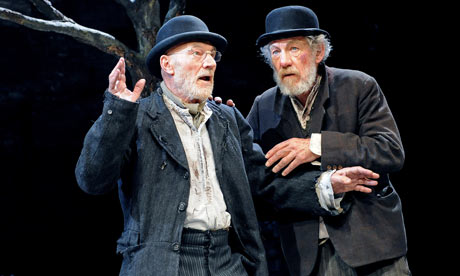
| Patrick Stewart as Vladimir and Ian McKellan as Estragon in a recent production |
To read the text of Waiting for Godot, click here.
Click here to watch Waiting for Godot with Barry McGovern and Johnny Murphy directed by Michael Lindsay-Hogg as part of the Beckett on Film series (with Turkish subtitles!).
Click here to hear Patrick Stewart, Ian McKellan, Ronald Pickup and Simon Callow discuss the challenges and the rewards of performing the play. "It's the hardest thing I have ever done," Patrick Stewart says.
Click here for "The Chinese Restaurant" episode of Seinfeld.
Click here for the script to that episode.
Click here for Waiting for Elmo, quite possibly the greatest Monsterpiece Theater ever.
(I) THE ABSURD
(i) From M. H. Abrams' A Glossary of Literary Terms:
Literature of the Absurd or Theater of the Absurd: The term is applied to a number of works in drama and prose fiction which have in common the sense that the human condition is essentially absurd, and that this condition can be adequately represented only in works of literature that are themselves absurd. Both the mood and dramaturgy were anticipated as early as 1896 in Alfred Jarry's French play Ubu roi(Ubu the King). The literature has its roots also in the movements of expressionism and surrealism, as well as in the fiction, written in the 1920s, of Franz Kafka (The Trial, Metamorphosis). The current movement, however, emerged in France after the horrors of World War II, as a rebellion against essential beliefs and values of traditional culture and traditional literature. This earlier tradition had included the assumptions that human beings are fairly rational creatures who live in an at least partially intelligible universe, that they are part of an ordered social structure, and that they may be capable of heroism and dignity even in defeat. After the 1940s, however, there was a widespread tendency, especially prominent in the existential philosophy of men of letters such as Jean-Paul Sartre and Albert Camus, to view a human being as an isolated existent who is cast into an alien universe, to conceive the universe are possessing no inherent truth, value, or meaning, and to represent human life -- in its fruitless search for purpose and meaning, as it moves from the nothingness whence it came toward the nothingness where it must end -- as an existence which is both anguished and absurd. As Camus said in The Myth of Sisyphus (1942),
"In a universe that is suddenly deprived of illusions and of light, man feels a stranger. His is an irremediable exile . . . This divorce between man and his life, the actor and his setting, truly constitutes the feeling of Absurdity."
Or as Eugene Ionesco, French author of The Bald Soprano (1949), The Lesson (1951), and other plays in the theater of the absurd, has put it: "Cut off from his religious, metaphysical, and transcendental roots, man is lost; all his actions become senseless, absurd, useless." Ionesco also said, in commenting on the mixture of moods in the literature of the absurd: "People drowning in meaninglessness can only be grotesque, their sufferings can only appear tragic by derision."
Samuel Beckett (1906-89), the most eminent and influential writer in this mode, both in drama and in prose fiction, was an Irishman living in Paris who often wrote in French and then translated his works in English. His plays, such as Waiting for Godot (1954) and Endgame(1958), project the irrationalism, helplessness, and absurdity of life in dramatic forms that reject realistic settings, logical reasoning, or a coherently evolving plot. Waiting for Godot presents two tramps in a waste place, fruitlessly and all but hopelessly waiting for an unidentified person, Godot, who may or may not exist and with whom they sometimes think they remember that they may have an appointment; as one of them remarks, "Nothing happens, nobody comes, nobody goes, it's awful." Like most works in this mode, the play is absurd in the double sense that it is grotesquely comic and also irrational and nonconsequential; it is a parody not only of the traditional assumptions of Western culture, but of the conventions and generic forms of traditional drama, and even of its own inescapable participation in the dramatic medium. The lucid but eddying and pointless dialogue is often funny, and pratfalls and other modes of slapstick are used to project the alienation and tragic anguish of human existence. Beckett's prose fiction, such as Malone Dies (1958) and The Unnameable (1960), present an antihero who plays out the absurd moves of the end game of civilization in a nonwork which tends to undermine the coherence of its medium, language itself. But typically Beckett's characters carry on, even if in a life without purpose, trying to make sense of the senseless and to communicate the uncommunicable.
Another French playwright of the absurd was Jean Genet (who combined absurdism and diabolism); some of the early dramatic works of the Englishman Harold Pinter and the American Edward Albee are in a similar mode. The plays of Tom Stoppard, such as Rosencrantz and Guildenstern Are Dead (1966) and Travesties (1974), exploit the devices of absurdist theater more for comic than philosophical ends. There are also affinities with this movement in the numerous recent works which exploit black comedy or black humor: baleful, naive, or inept characters in a fantastic or nightmarish modern world play out their roles in what Ionesco called a "tragic farce," in which the events are often simultaneously comic, horrifying, and absurd. Examples are Joseph Heller's Catch-22 (1961), Thomas Pynchon's V (1963), John Irving's The World According to Garp (1978), and some of the novels by the German Gunter Grass and the Americans Kurt Vonnegut, Jr., and John Barth. Stanley Kubrick's Dr. Strangelove is an example of black comedy in the cinema. More recently, some playwrights living in totalitarian regimes have used absurdist techniques to register social and political protest. See, for example, Largo Desolato (1987) by the Czech Vaclav Havel and The Island (1973), a collaboration by the South African writers Athol Fugard, John Kani, and Winston Ntshona.
(ii) From J. A. Cuddon's Penguin Dictionary of Literary Terms and Literary Theory:
The theatre of the absurd -- Camus in particular, but the movement in general -- "expounded in some detail a vision of life which was essentially absurd, without apparent purpose, out of harmony with its surroundings, sad to the point of anguish, and at the same time, in a laconic fashion, funny. [It] stresses the destructive nature of time, the feeling of solitude in a hostile world, the sense of isolation from other human beings."
(II) EXISTENTIALISM
Philosopher and writer Jean-Paul Sartre, from "L'existentialisme est un humanisme," a lecture delivered in Paris in 1946 (the complete text of the lecture, translated into English, is here):
"What is meant here by saying that existence precedes essence? It means that first of all, man exists, turns up, appears on the scene, and only afterwards defines himself [. . .]. Thus there is no human nature, since there is no God to conceive it [. . .]. Man is nothing else but what he makes of himself. Such is the first principle of existentialism. But if existence really does precede essence, man is responsible for what he is."
(III) ART AND THE PLANE OF THE FEASIBLE
In Beckett's Three Dialogues (1949), two characters, "D." and "B." hold a theoretical discussion regarding art and feasibility, art and what they call "the plane of the feasible":
D. What other plane can their be for the maker?
B. Logically, none. Yet I speak of an art turning from it in disgust, weary of its puny exploits, weary of pretending to be able of doing a little better the same old thing, of going a little further along a dreary road.
D. And preferring what?
B. The expression that there is nothing to express, nothing with which to express, nothing from which to express, no power to express, no desire to express, together with the obligation to express.
D. But that is a violently extreme and personal point of view, of no help to us in the matter.
B. - - - - - - - - -.
D. Perhaps that is enough for today.
(IV) BECKETT ON HABIT
From Beckett's Proust (1931):
"Habit is the ballast that chains the dog to his vomit. Breathing is habit. Life is habit. Rarely does one experience the moment when the boredom of living is replaced with the suffering of being."
(V) HAYDEN WHITE ON LIVING
Historian Hayden White, from "The Modernist Event" (1996):
"Nothing happens while you live. The scenery changes, people come and go out, that's all. There are no beginnings. Days are tacked on to days without rhyme or reason, an interminable, monotonous addition . . . That's living."
Click here to watch Waiting for Godot with Barry McGovern and Johnny Murphy directed by Michael Lindsay-Hogg as part of the Beckett on Film series (with Turkish subtitles!).
Click here to hear Patrick Stewart, Ian McKellan, Ronald Pickup and Simon Callow discuss the challenges and the rewards of performing the play. "It's the hardest thing I have ever done," Patrick Stewart says.
Click here for "The Chinese Restaurant" episode of Seinfeld.
Click here for the script to that episode.
Click here for Waiting for Elmo, quite possibly the greatest Monsterpiece Theater ever.
(I) THE ABSURD
(i) From M. H. Abrams' A Glossary of Literary Terms:
Literature of the Absurd or Theater of the Absurd: The term is applied to a number of works in drama and prose fiction which have in common the sense that the human condition is essentially absurd, and that this condition can be adequately represented only in works of literature that are themselves absurd. Both the mood and dramaturgy were anticipated as early as 1896 in Alfred Jarry's French play Ubu roi(Ubu the King). The literature has its roots also in the movements of expressionism and surrealism, as well as in the fiction, written in the 1920s, of Franz Kafka (The Trial, Metamorphosis). The current movement, however, emerged in France after the horrors of World War II, as a rebellion against essential beliefs and values of traditional culture and traditional literature. This earlier tradition had included the assumptions that human beings are fairly rational creatures who live in an at least partially intelligible universe, that they are part of an ordered social structure, and that they may be capable of heroism and dignity even in defeat. After the 1940s, however, there was a widespread tendency, especially prominent in the existential philosophy of men of letters such as Jean-Paul Sartre and Albert Camus, to view a human being as an isolated existent who is cast into an alien universe, to conceive the universe are possessing no inherent truth, value, or meaning, and to represent human life -- in its fruitless search for purpose and meaning, as it moves from the nothingness whence it came toward the nothingness where it must end -- as an existence which is both anguished and absurd. As Camus said in The Myth of Sisyphus (1942),
"In a universe that is suddenly deprived of illusions and of light, man feels a stranger. His is an irremediable exile . . . This divorce between man and his life, the actor and his setting, truly constitutes the feeling of Absurdity."
Or as Eugene Ionesco, French author of The Bald Soprano (1949), The Lesson (1951), and other plays in the theater of the absurd, has put it: "Cut off from his religious, metaphysical, and transcendental roots, man is lost; all his actions become senseless, absurd, useless." Ionesco also said, in commenting on the mixture of moods in the literature of the absurd: "People drowning in meaninglessness can only be grotesque, their sufferings can only appear tragic by derision."
Samuel Beckett (1906-89), the most eminent and influential writer in this mode, both in drama and in prose fiction, was an Irishman living in Paris who often wrote in French and then translated his works in English. His plays, such as Waiting for Godot (1954) and Endgame(1958), project the irrationalism, helplessness, and absurdity of life in dramatic forms that reject realistic settings, logical reasoning, or a coherently evolving plot. Waiting for Godot presents two tramps in a waste place, fruitlessly and all but hopelessly waiting for an unidentified person, Godot, who may or may not exist and with whom they sometimes think they remember that they may have an appointment; as one of them remarks, "Nothing happens, nobody comes, nobody goes, it's awful." Like most works in this mode, the play is absurd in the double sense that it is grotesquely comic and also irrational and nonconsequential; it is a parody not only of the traditional assumptions of Western culture, but of the conventions and generic forms of traditional drama, and even of its own inescapable participation in the dramatic medium. The lucid but eddying and pointless dialogue is often funny, and pratfalls and other modes of slapstick are used to project the alienation and tragic anguish of human existence. Beckett's prose fiction, such as Malone Dies (1958) and The Unnameable (1960), present an antihero who plays out the absurd moves of the end game of civilization in a nonwork which tends to undermine the coherence of its medium, language itself. But typically Beckett's characters carry on, even if in a life without purpose, trying to make sense of the senseless and to communicate the uncommunicable.
Another French playwright of the absurd was Jean Genet (who combined absurdism and diabolism); some of the early dramatic works of the Englishman Harold Pinter and the American Edward Albee are in a similar mode. The plays of Tom Stoppard, such as Rosencrantz and Guildenstern Are Dead (1966) and Travesties (1974), exploit the devices of absurdist theater more for comic than philosophical ends. There are also affinities with this movement in the numerous recent works which exploit black comedy or black humor: baleful, naive, or inept characters in a fantastic or nightmarish modern world play out their roles in what Ionesco called a "tragic farce," in which the events are often simultaneously comic, horrifying, and absurd. Examples are Joseph Heller's Catch-22 (1961), Thomas Pynchon's V (1963), John Irving's The World According to Garp (1978), and some of the novels by the German Gunter Grass and the Americans Kurt Vonnegut, Jr., and John Barth. Stanley Kubrick's Dr. Strangelove is an example of black comedy in the cinema. More recently, some playwrights living in totalitarian regimes have used absurdist techniques to register social and political protest. See, for example, Largo Desolato (1987) by the Czech Vaclav Havel and The Island (1973), a collaboration by the South African writers Athol Fugard, John Kani, and Winston Ntshona.
(ii) From J. A. Cuddon's Penguin Dictionary of Literary Terms and Literary Theory:
The theatre of the absurd -- Camus in particular, but the movement in general -- "expounded in some detail a vision of life which was essentially absurd, without apparent purpose, out of harmony with its surroundings, sad to the point of anguish, and at the same time, in a laconic fashion, funny. [It] stresses the destructive nature of time, the feeling of solitude in a hostile world, the sense of isolation from other human beings."
(II) EXISTENTIALISM
Philosopher and writer Jean-Paul Sartre, from "L'existentialisme est un humanisme," a lecture delivered in Paris in 1946 (the complete text of the lecture, translated into English, is here):
"What is meant here by saying that existence precedes essence? It means that first of all, man exists, turns up, appears on the scene, and only afterwards defines himself [. . .]. Thus there is no human nature, since there is no God to conceive it [. . .]. Man is nothing else but what he makes of himself. Such is the first principle of existentialism. But if existence really does precede essence, man is responsible for what he is."
(III) ART AND THE PLANE OF THE FEASIBLE
In Beckett's Three Dialogues (1949), two characters, "D." and "B." hold a theoretical discussion regarding art and feasibility, art and what they call "the plane of the feasible":
D. What other plane can their be for the maker?
B. Logically, none. Yet I speak of an art turning from it in disgust, weary of its puny exploits, weary of pretending to be able of doing a little better the same old thing, of going a little further along a dreary road.
D. And preferring what?
B. The expression that there is nothing to express, nothing with which to express, nothing from which to express, no power to express, no desire to express, together with the obligation to express.
D. But that is a violently extreme and personal point of view, of no help to us in the matter.
B. - - - - - - - - -.
D. Perhaps that is enough for today.
(IV) BECKETT ON HABIT
From Beckett's Proust (1931):
"Habit is the ballast that chains the dog to his vomit. Breathing is habit. Life is habit. Rarely does one experience the moment when the boredom of living is replaced with the suffering of being."
(V) HAYDEN WHITE ON LIVING
Historian Hayden White, from "The Modernist Event" (1996):
"Nothing happens while you live. The scenery changes, people come and go out, that's all. There are no beginnings. Days are tacked on to days without rhyme or reason, an interminable, monotonous addition . . . That's living."
