 |
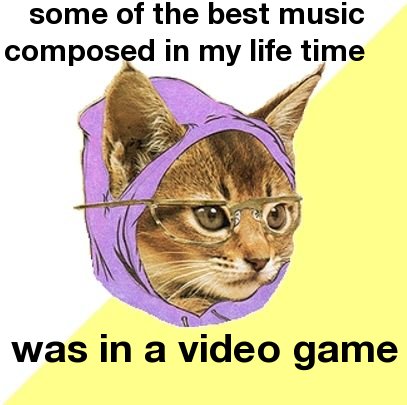
| An example of the "Hipster Kitty" meme, adapted from Craig Wheat's "Alison" |
Although guitar-driven music is still in many ways alive and well in a variety of genres and sub-genres, the dominant commercial forms of popular music in recent years—the kind of pop, dance, and hip-hop music we're most likely to hear when we're not even trying to hear music—fall, broadly speaking, under the heading of electronic music: music made with synthesizers, drum machines, or, more often than not, software emulations of either (or both).
As part of our ongoing examination of the avant-garde and the mainstream, let's trace a couple of features of mainstream pop music back to their avant-garde/experimental/underground roots, before looking briefly at the avant-garde roots of electronic music on the whole.
(I) From Bristol to Britney and Beyond: Dubstep
In the early years of the '00s, a new genre of UK dance music began to take shape out of dub, a particularly bass-heavy reggae subgenre, and the shuffling rhythms of two-step garage. A prototypical early example is "Gorgon Sound" by Horsepower Productions (2002).
A characteristic feature of dubstep is its distinctive approach to bass, which we hear in the above track at about 1:25. Technically, the effect is produced by modulating a particular parameter of the sound, the filter cutoff, with a low-frequency oscillator synced to the tempo of the piece. This sound has understandably become known as "wobble bass."
As dubstep slowly grew throughout the decade, wobble bass and the "bass drop" took on an increasingly prominent role, and became, to many, the defining features of the genre. Joker's "Tron" (2010) is an excellent later example of dubstep that positions the genre's trademark wobble bass very much in the foreground (bass drop at 0:55).
Much to the chagrin of what we might call dubstep purists, these characteristic features of the genre -- wobble bass and the bass drop -- would in time be be adopted by the makers of mainstream, radio-friendly pop. Britney Spears' "Hold it Against Me," produced by pop mainstays Max Martin and Dr. Luke, led to no small amount of outrage and finger-pointing in certain dark corners of the internet upon its early 2011 release (bass drop at 2:10).
These same features of dubstep taken up by Britney would soon thereafter go truly global, as we hear in Korean pop star Hyuna's "Bubble Pop," released in the summer of 2011 (bass drop at 2:20).
American dubstep producer Skrillex (Sonny John Moore)—who, in 2012, was nominated for five Grammy awards and won three, a clear signal of mainstream acceptance -- has spoken about the relationship between avant-garde/experimental/underground electronic music culture and the mainstream. "The more the stuff that is underground becomes mainstream, the more the underground is gonna change," Skrillex said in an MTV interview. "I think it's gonna inspire people to obviously do something different." Commenting specifically on Britney Spears' "Hold it Against Me," Skrillex said: "I thought the dubstep part was unnecessary. Not to say it was done wrong. I feel like it was very self-aware and consciously put in there to be 'the dubstep part.' I can see a lot of people getting pissed about it — the purist dubstep and drum and bass fans — but at the end of the day, it's cool that people are trying new things. Sooner or later, anything that happens in the underground — be it watered down or not — it always makes itself into the mainstream. It's cool to hear." Interestingly, on the whole, Skrillex praised the song: "I thought the track was great overall. I'll be honest, man: I love Max Martin. I think he's an absolute genius. And Dr. Luke did it, right? I think they are a fucking dream team. I love the track!"
 |
| Skrillex, not to be mistaken for Sarah Gilbert in the rôle of Darlene Connor on the Roseanne series—recall Roseanne Barr on Seinfeld and Beckett! |
In the years since, dubstep has become ubiquitous, a sound so thoroughly part of the mainstream, that it is used to sell Weetabix and Nerds (among many, many other things).
(II) From Lo-bat to Lisa Simpson: Chiptune
Chiptune began as an obscure subgenre of electronic music in which artists coaxed sound and rhythm out of the 8-bit sound chips of obsolete computers and video game consoles, resulting in deliberately lo-fi, glitchy music that recalls the rudimentary video game soundtracks of thirty (or more) years ago. Lo-bat's "Tizzy" (2004) is a prime example of the genre, in which we hear an artist working with the notoriously difficult Nintendo Game Boy sound chip to produce blips and bleeps that initially sound almost random before they cohere.
These sounds attracted the attention of other experimental electronic musicians, some of whom sampled liberally from these tracks released under non-commercial Creative Commons licences. Crystal Castles, a Toronto duo that achieved considerable critical acclaim in the UK (and some in North America), came under fire from the small but devoted chiptune community when the band used elements of compositions by Lo-bat (and others) and failed to credit or acknowledge their sources. One song that came under particular scrutiny is Crystal Castles' "Alice Practice" (2006), which in 2011 appeared high on NME's list of the best songs of the previous fifteen years.
Crystal Castles were themselves allegedly sampled but not credited by hip-hop producer Timbaland, whose "Ayo Technology" (2007) with 50 Cent and Justin Timberlake bares a striking resemblance to Crystal Castle's "Courtship Dating." But regardless of who was sampling whom, properly or improperly, chiptune music was no longer an obscure, technical curiosity; it was, instead, a vital part of a top-five 50 Cent/Justin Timberlake single. At the same time, technological innovation meant that the sounds that had formerly been all but inaccessible to the non-specialist became comparatively easy to manipulate. (Despite this mainstream success, chiptune nevertheless retained its underground appeal through the end of the decade, as we hear evidenced in Joker's chiptune-influenced "Digidesign" [2009]).
Chiptune would reach its broadest audience to date a year later, when Kesha's "TiK ToK," co-written with and produced by Benny Blanco and Dr. Luke (again), would become the best selling single of 2010, with nearly thirteen million songs sold internationally in an era where sales figures only scratch the surface of a song's true presence in the culture.
A comparatively slight six million people were exposed to "TiK ToK"—and thus to sounds that had been the exclusive domain of the avant-garde less than a decade before—when The Simpsons replaced their entire opening with a performance of the song.
(III) The Popular Synthesis of Chiptune and Dubstep: Flo Rida's "Good Feeling" (2012) (produced by Cirkut and Dr. Luke)
Subgeneric worlds collide at 2:45:
(IV) "The Reason Music Sounds Like It Does Today": Kraftwerk, Stockhausen, Schaeffer
All modern electronic music—be it pop, house, techno, trance, IDM, hip hop, everything—is deeply indebted to the pioneering German group Kraftwerk, whose avant-garde experiments in the early 1970s gradually cohered into the conceptual "techno pop" they have performed in the decades since. "The Robots" (1978) is perhaps their signature piece.
Kraftwerk drew inspiration from Karlheinz Stockhausen's earlier experiments with electronic sound generation and tape manipulation, such as "Studie II (Electronik Musiche)" (1954) and his enormously influential "Gesang der Jünglinge" (1956).
Stockhausen's work in turn descends from that of Pierre Schaeffer, the central figure in the avant-garde school of musique concrète, in which the artist records sounds as he or she finds them in the world, and manipulates them, sometimes minimally, to produce a composition. A notable example is Schaeffer's "Etude aux chemin de fer" (1948).
(II) From Lo-bat to Lisa Simpson: Chiptune
Chiptune began as an obscure subgenre of electronic music in which artists coaxed sound and rhythm out of the 8-bit sound chips of obsolete computers and video game consoles, resulting in deliberately lo-fi, glitchy music that recalls the rudimentary video game soundtracks of thirty (or more) years ago. Lo-bat's "Tizzy" (2004) is a prime example of the genre, in which we hear an artist working with the notoriously difficult Nintendo Game Boy sound chip to produce blips and bleeps that initially sound almost random before they cohere.
These sounds attracted the attention of other experimental electronic musicians, some of whom sampled liberally from these tracks released under non-commercial Creative Commons licences. Crystal Castles, a Toronto duo that achieved considerable critical acclaim in the UK (and some in North America), came under fire from the small but devoted chiptune community when the band used elements of compositions by Lo-bat (and others) and failed to credit or acknowledge their sources. One song that came under particular scrutiny is Crystal Castles' "Alice Practice" (2006), which in 2011 appeared high on NME's list of the best songs of the previous fifteen years.
Crystal Castles were themselves allegedly sampled but not credited by hip-hop producer Timbaland, whose "Ayo Technology" (2007) with 50 Cent and Justin Timberlake bares a striking resemblance to Crystal Castle's "Courtship Dating." But regardless of who was sampling whom, properly or improperly, chiptune music was no longer an obscure, technical curiosity; it was, instead, a vital part of a top-five 50 Cent/Justin Timberlake single. At the same time, technological innovation meant that the sounds that had formerly been all but inaccessible to the non-specialist became comparatively easy to manipulate. (Despite this mainstream success, chiptune nevertheless retained its underground appeal through the end of the decade, as we hear evidenced in Joker's chiptune-influenced "Digidesign" [2009]).
Chiptune would reach its broadest audience to date a year later, when Kesha's "TiK ToK," co-written with and produced by Benny Blanco and Dr. Luke (again), would become the best selling single of 2010, with nearly thirteen million songs sold internationally in an era where sales figures only scratch the surface of a song's true presence in the culture.
A comparatively slight six million people were exposed to "TiK ToK"—and thus to sounds that had been the exclusive domain of the avant-garde less than a decade before—when The Simpsons replaced their entire opening with a performance of the song.
(III) The Popular Synthesis of Chiptune and Dubstep: Flo Rida's "Good Feeling" (2012) (produced by Cirkut and Dr. Luke)
Subgeneric worlds collide at 2:45:
All modern electronic music—be it pop, house, techno, trance, IDM, hip hop, everything—is deeply indebted to the pioneering German group Kraftwerk, whose avant-garde experiments in the early 1970s gradually cohered into the conceptual "techno pop" they have performed in the decades since. "The Robots" (1978) is perhaps their signature piece.
Kraftwerk drew inspiration from Karlheinz Stockhausen's earlier experiments with electronic sound generation and tape manipulation, such as "Studie II (Electronik Musiche)" (1954) and his enormously influential "Gesang der Jünglinge" (1956).
Stockhausen's work in turn descends from that of Pierre Schaeffer, the central figure in the avant-garde school of musique concrète, in which the artist records sounds as he or she finds them in the world, and manipulates them, sometimes minimally, to produce a composition. A notable example is Schaeffer's "Etude aux chemin de fer" (1948).
V) Everybody in the Place by Jeremy Deller, Sisters with Transistors by Lisa Rovner
Jeremy Deller's Everybody in the Place is a truly lovely lecture delivered to a London high school class that touches on all of the processes outlined in this post—the archival footage is to be treasured!
From the promotional materials: "[. . .] the new film written and directed by Jeremy Deller, explores the social history of the UK between 1985 and 1993 through the lens of acid house and rave music. The film is based on a real-life lecture given to a class of students in London."
Watch it here.
Lisa Rovner's excellent 2020 documentary Sisters with Transistors takes us further back: it offers "the remarkable untold story of electronic music’s female pioneers, composers who embraced machines and their liberating technologies to utterly transform how we produce and listen to music today. The film maps a new history of electronic music through the visionary women whose radical experimentations with machines redefined the boundaries of music, including Clara Rockmore, Daphne Oram, Bebe Barron, Pauline Oliveros, Delia Derbyshire, Maryanne Amacher, Eliane Radigue, Suzanne Ciani, and Laurie Spiegel." (from the film's website)
Watch the trailer here.
(VI) Another Intersection Between Popular Music and The Avant-Garde
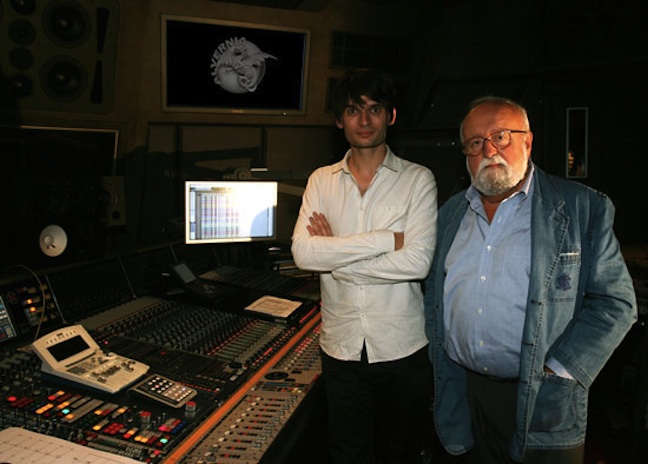
In 2011, both the electronic artist Richard D. James (who often performs as Aphex Twin) and Radiohead guitarist and composer Jonny Greenwood performed arrangements of the great Polish avant-garde composer Krzysztof Penderecki's "Threnody for the Victims of Hiroshima" and "Polymorphia" as part of the European Cultural Congress in Wroclaw. Penderecki himself was on hand for the performances. Read about the event here. Aphex Twin's performance is here.
(VII) BREAKING NEWS: There is something called "seapunk," and you have never heard of it, and it is already over
1) "In the Water," Beat Connection (2010). Writing at Pitchfork, Larry Fitzmaurice describes the song this way: "The boys are singing about being in the water, and their vocals sound dripping wet, as every elided syllable glistens under light."
2) "Atlantis," Azelia Banks (2012). (You might know Azelia Banks' 2011 underground hit "212")
(VIII) From a different angle: The Devil Wears Prada
(IX) David Bowie thinks something more sinister is at work
And he makes a compelling argument.
(X) Not Even Your Food is Safe: "Toward a Theory of Normcore Food"
Johannah King-Slutzky's "Toward a Theory of Normcore Food" (The Awl, 2015) is the finest piece of criticism conceivable on its subject.
She writes:

"These principles don’t just make dialectical sense; they also reproduce normcore fashion’s source texts. Although normcore’s boundaries are contested, one premise about normcore fashion has remained universally unchallenged: Jerry and George would have worn it on Seinfeld. The question that naturally follows is, What would Jerry Seinfeld and George Costanza have eaten?"
Johannah King-Slutzky's "Toward a Theory of Normcore Food" (The Awl, 2015) is the finest piece of criticism conceivable on its subject.
She writes:

"Small-batch pickles, Greek yogurt, and quinoa are all high-stakes trendy foods with loads of moral and aesthetic baggage. We ingest them to prove to ourselves that we are ethical by way of being health-conscious, multicultural, hard workers. Of course, the labor required to produce and consume a pickle won’t have any measurable effect on the health of your body, the quality of your soul, or the degree of your authenticity. This constellation of foods, which might be crudely labeled 'hipster food,' are the means by which our sense of goodness is outsourced through our gut.
"The antithetical culinary trend of hipster food, snackwave, seizes on its puritanism and refutes it through slovenliness, shopping mall imagery, and pro-capitalist branding. It is the first prong in the anti-hipster food backlash. As Hazel Cills and Gabrielle Noone write in The Hairpin, snackwave 'trickled up from Tumblr dashboards' to counter 'Pinterest-worthy twee cupcake recipes.' It is chiefly defined by excessive consumption of junk food and is often couched in the doctrine that women, especially, can do whatever they want to their bodies. An important element of snackwave is its individualism: the meal is communal, the snack is individual."
And:
"Normcore food is all of the following:
1. Ugly
2. Homemade but not artisanal
3. Would have been popular in the early nineties without becoming a nostalgia fetish item
4. Healthy but not cleansing
5. Can be made or purchased in batches large enough for a family but is usually eaten alone
6. Might use ethnic ingredients, but never in order to claim authenticity
2. Homemade but not artisanal
3. Would have been popular in the early nineties without becoming a nostalgia fetish item
4. Healthy but not cleansing
5. Can be made or purchased in batches large enough for a family but is usually eaten alone
6. Might use ethnic ingredients, but never in order to claim authenticity
Like snackwave, normcore food takes its cues from the internet."
And crucially:
"These principles don’t just make dialectical sense; they also reproduce normcore fashion’s source texts. Although normcore’s boundaries are contested, one premise about normcore fashion has remained universally unchallenged: Jerry and George would have worn it on Seinfeld. The question that naturally follows is, What would Jerry Seinfeld and George Costanza have eaten?"
