 |
A map of Scandinavia in Beowulf's day (Beowulf: A Critical Companion, 2003) |
"Correct and sober taste may refuse to admit that there can be an interest for us—the proud we that includes all intelligent living people—in ogres and dragons; we then perceive its puzzlement in face of the odd fact that it has derived great pleasure from a poem that is actually about these unfashionable creatures." -- J. R. R. Tolkien, "The Monsters and the Critics" (1936)
"Just don't take any course where they make you read Beowulf" -- Woody Allen, Annie Hall (1977)
The text is available here; Seamus Heaney also offers us a near-complete reading of his translation in two parts.
Perhaps the best way to approach Beowulf is to simply listen. There is substantial (though inconclusive) evidence that indicates that the poem existed for generations as a tale that was told and retold before it was ultimately transcribed in the lone manuscript that now contains it; listening to the poem read aloud grants us a window into that experience.
However, I think it's probably for the best that we also have access to the written document as well. As you listen to the poem, you might very well want to follow along with the written text. It will help you keep the names straight, if nothing else. We are not going to concern ourselves with the intricacies of the Old English language (also called "Anglo-Saxon"), but do have a look at a few lines of the poem in its original language, if for no other reason than to see just how foreign it is, and yet at times how strangely familiar, too. You can hear the opening lines read here.
(I) Literary Terms
epic: An epic is a long narrative poem, on a grand scale, about the deeds of warriors and heroes. It is a polygonal [multi-sided], ‘heroic’ story incorporating myth, legend, folk tale, and history. Epics are often of national significance in the sense that they embody the history and aspirations of a nation in a lofty or grandiose manner.
alliteration: a figure of speech in which consonants, especially at the beginning of words, or stressed syllables, are repeated. It is a very old device indeed in English verse (older than rhyme) and is common in verse generally. It is used occasionally in prose. In OE poetry alliteration was a continual and essential part of the metrical scheme and until the Middle Ages was often used thus. However, alliterative verse becomes increasingly rare after the end of the 15th C. and alliteration […] tends more to be reserved for the achievement of the special effect.
archetype: Archetype (Gk ‘original pattern’) A basic model from which copies are made; therefore a prototype. In general terms, the abstract idea of a class of things which represents the most typical and essential characteristics shared by the class; thus a paradigm or exemplar. An archetype is atavistic and universal, the product of ‘the collective unconscious’ and inherited from our ancestors. The fundamental facts of human existence are archetypal: birth, growing up, love, family and tribal life, dying, death, not to mention the struggle between children and parents, and fraternal rivalry. Certain character or personality types have become established as more or less archetypal. For instance: the rebel, the Don Juan (womanizer), the all-conquering hero, the braggadocio, the country bumpkin, the local lad who makes good, the self-made man, the hunted man, the siren, the witch and femme fatale, the villain, the traitor, the snob and the social climber, the guilt-ridden figure in search of expiation, the damsel in distress, and the person more sinned against than sinning. Creatures, also, have come to be archetypal emblems. For example, the lion, the eagle, the snake, the hare, and the tortoise. Further archetypes are the worse the paradisal garden and state of ‘pre-Fall’ innocence. Themes include the arduous quest or search, the pursuit of vengeance, the overcoming of difficult tasks, the descent into the underworld, symbolic fertility rites and redemptive rituals. The archetypal has always been present and diffused in human consciousness.
(all of the above definitions taken from J. A. Cuddon's Penguin Dictionary of Literary Terms and Literary Theory, 4th ed., 1999)
(II) Translating Beowulf: A Few Examples
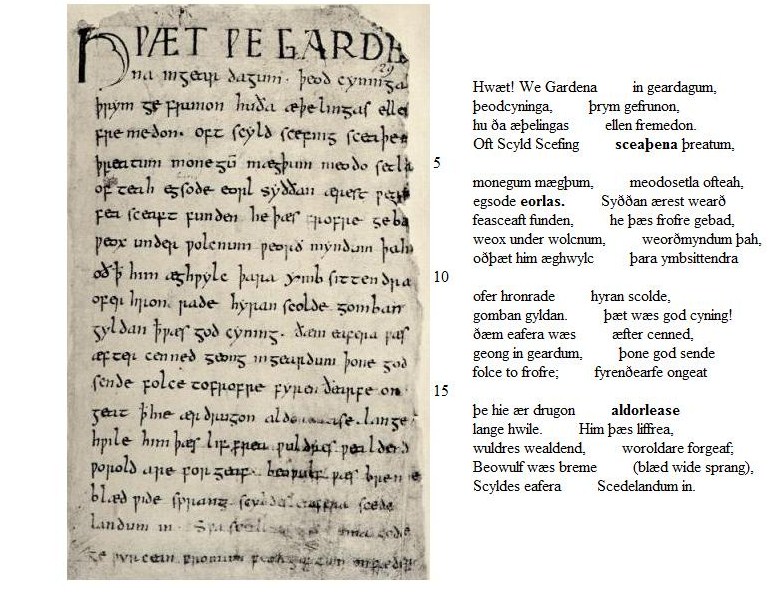 |
The first page of the Beowulf manuscript, and a transcription. |
Lesslie Hall (1892):
Lo! the Spear-Danes’ glory through splendid achievements
The folk-kings’ former fame we have heard of,
How princes displayed then their prowess-in-battle.
Oft Scyld the Scefing from scathers in numbers
From many a people their mead-benches tore.
Since first he found him friendless and wretched,
The earl had had terror: comfort he got for it,
Waxed ’neath the welkin, world-honor gained,
Till all his neighbors o’er sea were compelled to
Bow to his bidding and bring him their tribute:
An excellent atheling!
Howell Chickering (1977):
Listen! We have heard of the glory of the Spear-Danes
in the old days, the kings of tribes --
how noble princes showed great courage!
Often Scyld Scefing seized mead-benches
from enemy troops, from many a clan;
he terrified warriors, even though first he was found
a waif, helpless. For that came a remedy,
he grew under heaven, prospered in honors
until every last one of the bordering nations
beyond the whale-road had to heed him,
pay him tribute. He was a good king!
R. M. Liuzza (2000):
Listen!
We have heard of the glory in bygone days
of the folk-kings of the spear-Danes,
how those noble lords did lofty deeds.
Often Scyld Scefing seized the mead benches
from many tribes, troops of enemies,
struck fear into earls. Though he first was
found a waif, he awaited solace for that --
he grew under heaven and prospered in honor
until every one of the encircling nations
over the whale's-riding had to obey him,
grant him tribute. That was a good king!
Seamus Heaney (2000):
So. The Spear-Danes in days gone by
and the kings who ruled them had courage and greatness.
We have heard of those princes' heroic campaigns.
There was Shield Sheafson, scourge of many tribes,
a wrecker of mead-benches, rampaging among foes.
This terror of the hall-troops had come far.
A foundling to start with, he would flourish later on
as his powers waxed and his worth was proved.
In the end each clan on the outlying coasts
beyond the whale-road had to yield to him
and begin to pay tribute. That was one good king.
J. R. R. Tolkien's prose translation (1926, published 2014)
Lo! the glory of the kings of the people of the Spear-Danes in
days of old we have heard tell, how those princes did deeds
of valor. Oft Scyld Scefing robbed the hosts of foemen,
many peoples, of the seats where they drank their mead, laid
fear upon men, he who was first found forlorn; comfort for
that he lived to know, mighty grew under heaven, throve in
honour, until all that dwelt nigh about, over the sea where the
whale rides, must hearken to him and yield him tribute -- a
good king was he!
HEY now hear
what spears of Danes
in days of years gone
by did, what deeds made
their power their glory —
their kings & princes:
SCYLD SCEFING,
wretched foundling,
grew under open skies & in him glory thrived
& all who threatened his meadhall ran in terror
& all neighboring nations brought him gold
following whaleroads.
Here is how I read it:
Now, we have heard the yore-day glory
of the ancient Spear-Dane kings,
how the noble-blooded boldly flourished.
Scyld Scefing threatened enemies,
ripped tribes from mead benches,
frightened brave men. At first
a foundling, he awaited comfort;
glory-minded, he strengthened under skies
until all who held the lands
beyond the whale-road heard him,
yielded tribute. That was a good king.
A complication: maybe literally everyone has misread the poem's very first word until now.
(III) Totally Optional Reading for Beowulf Enthusiasts
 |
Fenrir and Odin as depicted by Tore Knutsen |
(i) RAGNAROK from Kevin Crossley-Holland The Norse Myths (1981), also published as The Penguin Book of Norse Myths: Gods of the Vikings:
An axe-age, a sword-age, shields will be gashed: there will be a wind-age and a wolf-age before the world is wrecked.
First of all Midgard will be wrenched and racked by wars for three winters. Fathers will slaughter sons; brothers will be drenched in one another's blood. Mothers will desert their menfolk and seduce their own sons; brothers will bed with sisters.
Then Fimbulvetr, the winter of winters, will grip and throttle Midgard. Driving snow clouds will converge from north and south and east and west. There will be bitter frosts, biting winds; the shining sun will be helpless. Three such winters will follow each other with no summers between them.
So the end will begin. Then the children of the old giantess in Iron Wood will have their say: the wolf Skoll will seize the sun between his jaws and swallow her -- he will spatter Asgard with gore; and his brother Hati will catch the moon and mangle him. The stars will vanish from the sky.
The earth will start to shudder then. Great trees will sway and topple, mountains will shake and rock and come crashing down, and every bond and fetter will burst. Fenrir will run free.
Eggther, watchman of the giants, will sit on his grave mound and strum his harp, smiling grimly. Nothing escapes the red cock Fjalar; he will crow to the giants from bird-wood. At the same time the cock who wakes the warriors every day in Valhalla, golden combed Gullinkambi, will crow to the gods. A third cock, rust red, will raise the dead in Hel.
The sea will rear up and waves will pummel the shore because Jormungand, the Midgard Serpent, is twisting and writhing in fury, working his way on to dry land. And in those high seas Naglfar will break loose -- the ship made from dead men's nails. The bows and the waist and the stern and the hold will be packed with giants and Hrym will stand at the helm, heading towards the plain Vigrid. Loki too, free from his fetters, will take to the water; he will set sail towards Vigrid from the north and his deadweight will be all that ghastly crew in Hel.
Then the brothers Fenrir and Jormungand will move forward side by side. Fenrir's slavering mouth will gape wide open, so wide that his lower jaw scrapes against the ground and his upper jaw presses against the sky; it would gape still wider if there were more room. Flames will dance in Fenrir's eyes and leap from his nostrils. With each breath, meanwhile, Jormungand will spew venom; all the earth and the sky will be splashed and stained with his poison.
The world will be in uproar, the air quaking with booms and blares and their echoes. Then the sons of Muspell will advance from the south and tear apart the sky itself as they, too, close in on Vigrid. Surt will lead them, his sword blazing like the sun itself as they, too, close in on Vigrid. And as they cross the Bifrost, the rainbow bridge will crack and break behind them. So all the giants and all the inmates of Hel, and Fenrir and Jormungand, and Surt and the blazing sons of Muspell will gather on Vigrid; they will all but fill that plain that stretches one hundred and twenty leagues in every direction.
The gods, meanwhile, will not be idle. Heimdall will leave his hall, Himinbjorg, and raise the great horn Gjall to his mouth. He will sound such a blast that it will be heard throughout the nine worlds. All the gods will wake at once and meet in council. Then Odin will mount Sleipnir and gallop to Mimir's spring and take advice from Mimir there.
Yggdrasill itself will moan, the ash that always was and waves over all that is. Its leaves will tremble, its limbs shiver and shake even as two humans take refuge deep within it. Everything in heaven and in earth and Hel will quiver.
Then all the Aesir and all the Einherjar in Valhalla will arm themselves. They will don their helmets and their coats of mail, and grasp their swords and spears and shields. Eight hundred fighting men will forge through each of the hall's five hundred and forty doors. That vast host will march towards Vigrid and Odin will ride at their head, wearing a golden helmet and a shining corslet, brandishing Gungnir.
Odin will make straight for the wolf Fenrir; and Thor, right beside him, will be unable to help because Jormungand will at once attack him. Freyr will fight the fire against giant Surt. And when Surt whirls his flaming blade, Freyr will rue the day that he gave his own good sword to his servant Skirnir. It will be a long struggle, though, before Freyr succumbs. The hound Garm from Gnipahellir will leap at the throat of one-handed Tyr and they will kill one another. The age-old enemies Loki and Heimdall will meet once more and each will be the cause of the other's death.
Thor, Son of Earth, and gaping Jormungand have met before too; they are well matched. At Vigrid the god will kill the serpent but he will only be able to stagger back nine steps before he falls dead himself, poisoned by the venom Jormungand spews over him.
Odin and Fenrir were the first to engage and their fight will be fearsome. In the end, though, the wolf will seize Allfather between his jaws and swallow him. That will be the death of Odin.
At once his son Vidar will stride forward and press one foot on Fenrir's bottom jaw -- and the shoe he will wear then has been a long time in the making; it consists of all the strips and bits of leather pared off the heels and toes of new shoes since time began, all the leftovers thrown away as gifts for the god. Then Vidar will take hold of Fenrir's other jaw and tear the wolf apart, so avenging his father.
Then Surt will fling fire in every direction. Asgard and Midgard and Jotunheim and Niflheim will become furnaces -- places of raging flame, swirling smoke, ashes, only ashes. The nine worlds will burn and the gods will die. The Einherjar will die, men and women and children in Midgard will die, elves and dwarfs will die, birds and animals will die. The sun will be dark and there will be no more stars in the sky. The earth will sink into the sea.
The earth will rise again out of the water, fair and green. The eagle will fly over cataracts, swoop into the thunder and catch fish under crags. Corn will ripen in fields that were never sown.
Vidar and Vali will still be alive; they will survive the fire and the flood and make their way back to Idavoll, the shining plain where palaces once stood. Modi and Magni, sons of Thor, will join them there, and they will inherit their father's hammer, Mjollnir. And Balder and Hod will come back from the world of the dead; it will not be long before they, too, tread the new green grass on Idavoll. Honir will be there as well, and he will hold the wand and foretell what is to come. The sons of Vili and Ve will make up the new number, the gods in heaven, home of the winds.
They will sit down in the sunlight and begin to talk. Turn by turn, they will call up such memories, memories such as are known to them alone. They will talk over many things that happened in the past, and the evil of Jormungand and the wolf Fenrir. And then, amongst the waving grass, they will find golden chessboards, treasures owned once by the Aesir, and gave at them in wonder.
Many courts will rise once more, some good, some evil. The best place of all will be Gimli in heaven, a building fairer than the sun, roofed with gold. That is where the rulers will live, at peace with themselves and each other. Then there will be Brimir on Okolnir, where the ground is always warm underfoot; there will always be plenty of good drink there for those who have a taste for it. And there will be Sindri, a fine hall that stands in the dark mountains of Nidafjoll, made wholly of red gold. Good men will live in these places.
But there will be another hall on Nastrond, the shore of corpses. That place in the underworld will be as vile as it is vast; all its doors will face north. Its walls and roof will be made of wattled snakes, their heads facing inward, blowing so much poison that it runs in rivers through the hall. Oath breakers and murderers and philanderers will wade through those rivers. Nidhogg, too, will outlive the fire and the flood and under Yggdrasill he will suck blood from the bodies of the dead.
The two humans who hid themselves deep within Yggdrasill -- some say Hoddmimir's Wood -- will be called Lif and Lifthrasir. Surt's fire will not scorch them; it will not even touch them, and their food will be the morning dew. Through the branches, through the leaves, they will see light come back, for before the sun is caught and eaten by the wolf Skoll, she will give birth to a daughter no less fair than herself, who will follow the same sky-path and light the world.
Lif and Lifthrasir will have children. Their children will bear children. There will be life and new life, life everywhere on earth. That was the end; and this is the beginning.
(ii) THE DEATH OF KING ARTHUR from Sir Thomas Malory's Le Morte D'Arthur (1485):
"Then the king gat his spear in both his hands, and ran toward Sir Mordred, crying: Traitor, now is thy death-day come. And when Sir Mordred heard Sir Arthur, he ran until him with his sword drawn in his hand. And there King Arthur smote Sir Mordred under the shield, with a foin of his spear, throughout the body, more than a fathom. And when Sir Mordred felt that he had his death wound he thrust himself with the might that he had up to the bur of King Arthur’s spear. And right so he smote his father Arthur, with his sword holden in both his hands, on the side of the head, that the sword pierced the helmet and the brain-pan, and therewithal Sir Mordred fell stark dead to the earth; and the noble Arthur fell in a swoon to the earth, and there he swooned ofttimes. And Sir Lucan the Butler and Sir Bedivere ofttimes heaved him up. And so weakly they led him betwixt them both, to a little chapel not far from the seaside."
For more Arthur (much more: 4346 lines more) here is Arthur Is Your Enemy Forever, my translation of the fourteenth-century Middle English Alliterative Morte Arthure, available at the following address: https://drive.google.com/file/d/0B6u4ciCfddnzN3BPU0pjVjhQZEU/view?usp=sharing&resourcekey=0-MPPPTiAJ5iOArHvY-e4WpA
(iii) THE MUTUAL KILL trope as described at the great TV Tropes site:
"Two characters commit fatal damage against each other in the same confrontation.
Particularly heart-tugging when it appears the hero has won, it's over. . . and then they slowly drop to their knees, blood trickling from the side of their mouth."
Much, much more here.
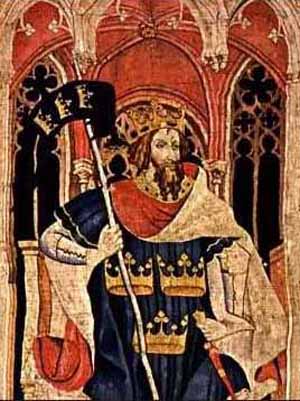
(iv) BEOWULF VS. KING ARTHUR as debated on a Naruto forum, of all places.
Some highlights:
"Arthur wins due to excalibur haxx."
"Arthur got manhandled and thrown down from his horse by Sir Bors, Lancelot's cousins.Beowulf would take the sword out of Arthur's hand and proceed with beatdown."
"Beowulf defeated a dragon while being old."
"Beowulf is far too much of a pimp for king Authur."
"Depends, does Beowulf have clothes on? This is very important."
"[Beowulf defeated a dragon while being old] With help and he died, while doing so. I would still root for him due to being physically more impressive ripping Grendel's arm off, wrestling his mother, hitting the dragon so hard his magic sword breaks."
"Beowulf has massive stamina. He swam a race in the sea for like a week, and killed multiple sea monsters on his own, in the water, during bad weather. Way too badass."
"Beowulf is pre-christian. Arthur is Christian. Though Geoffery of Monmouth he was very bloodthirsty. In early Malory's work, Arthur was slaughtering hundreds till the blood went up to his knee while he was sitting on his horse. Merlin had to literally come down and say, "Thou hast never done." translation: Haven't you killed enough This was Pre-Retcon Arthur when he got Excalibur from the stone instead of the Lady of the Lake. Pre-Retcon King Arthur would be a better match than post-retcon moron imbecile cuckold."
"I don't see why is Arthur portrayed as an honest man in the media. His most known enemy, Mordred, is also his illegitimate son in one of his portrayals."
"Mordred is not just Arthur's son. He is Arthur's Nephew/Son. Morgause was his sister hence Mordred was both nephew and son."
"Beowulf rips his arm off like he did with Grendel. Then beats him with it."
"Beowulf had the strength of 30 men. Galahad the greatest of knights had the strength of 10. But then again Galahad was known for slaying dragons, while Beowulf only tied. It would be a good fight."
"I wouldn't powerscale from dragons, they can be pretty inconsistent. Look at Fafner(ok a dwarf transformed by Odin) from the Sigurdlegend and than compare him to dragons in some other myth that just get fodderized."
(IV) Racists Will Ruin Beowulf if We Let Them (Let's Not Let Them)
 |
| The Mighty Thor, tragically co-opted by Nazis |
In an article titled "Beowulf: Prince of the Geats, Nazis, and Odinists," Richard Scott Nokes tells us of the viciously racist on-line attacks leveled against a low-budget film adaptation that depicts Beowulf as the son of an African explorer. Nokes argues that this is regrettably not the first time the poem has been taken up by racists and misused in support of their abhorrent views:
"Those of us who deal with Beowulf in the relatively sanitized conditions of academia might do well to remember that the poem has an ardent readership among those who find in it support for ideologies most scholars would find ridiculous or repugnant. Their response to the poem must be acknowledged as part of the 'cultural heritage' of Beowulf; their arguments, however offensive, can reveal some of the ways that popular audiences read medieval texts."
Nokes also writes:
"Beowulf is by no means unique in medieval literature in serving the interests of nationalism. In Inventing the Middle Ages, Norman E. Cantor traced the deep interest in and profound impact of the Nazis upon medieval studies, particularly in the ways in which they promoted the use of history, linguistics, and folklore as tools for shaping a myth of pan-Germanic identity. Though they used medieval studies for their own purposes, the Nazis were part of a long tradition of underwriting national identity through medieval literature [. . .]. Scholars and teachers of Beowulf tend either to ignore or downplay this aspect of Beowulf’s critical reception, or they may work actively to challenge such readings through more sophisticated analysis of the poem’s origins and history. Unlike many other medieval works, however, Beowulf has a life beyond the academic world and a place in popular culture, where the nuances of scholarly caution and restraint have little effect."
J. P. Zmirak (whose political views, broadly, I do not wish to endorse or promote) tells us:
"As a teenager, J.R.R. Tolkien neglected his Latin and Greek to study Norse. And Finnish. And Anglo-Saxon. Tolkien thrilled at studying medieval eddas and sagas, and mastering dusty grammars to decode half-forgotten tales. At Oxford, he made himself the university’s expert in Nordic literature, and won a prestigious chair which he’d hold for the next four decades.
What attracted Tolkien to these tales was their unique, heroic ethos. Written down by recently Christianized barbarians, stories such as Beowulf and Sir Gawain and the Green Knight intertwined the old, pagan values of individualism, courage and promise-keeping with Biblical themes of self-sacrifice, defense of the helpless, and piety towards the One God. Thus were the warriors of the North civilized, and urged to restrain their swords by the codes of Hebrew prophets and Christian theologians. The grandsons of the Viking raiders began to bind themselves to the Ten Commandments and Augustine’s 'just war' theory."
Zmirak continues:
"It is ironic that even as Tolkien wrote to immortalize the great synthesis of Northern heroism with Biblical morality, modern barbarians labored to reverse it. The proto-Nazi 'Völkisch' movement, born in the blood and humiliation of Napoleon’s conquest of Germany, had for a century agitated against Judaeo-Christian 'softness,' in favor of pagan ruthlessness. (Peter Viereck’s Metapolitics [Capricorn, 1961] traces this re-barbarization of German thought in the 19th century.) Völkisch boosters of Nordic literature ignored its heroic individualism in favor of its residues of pagan tribalism, 'deconstructing' the Judaeo-Christian elements as 'inauthentic' overlays on the 'pure' originals. The artistic pinnacle of this project appeared in Wagner’s grand operas, based on 'pure' pagan sources. Its political apogee came with the victory of a Völkish-socialist demagogue in Germany.
"While Adolf Hitler was careful at first to conceal his neo-pagan agenda, his followers were not: Heinrich Himmler created the SS explicitly as a pagan parody of the Society of Jesus, conducted extensive research attempting to rehabilitate medieval witchcraft, and held torchlit liturgies to Odin and other Norse gods. Hitler’s ideologist, Alfred Rosenberg, issued tracts denouncing the Gospels. Josef Goebbels aspired to wipe out 'after the last Jew, the last priest.' Hitler’s ally, General Erich Ludendorff, called for the abolition of Christianity in Germany. By 1936, Hitler was suppressing Catholic trade unions, movements and schools, and forming amongst Protestants a militaristic 'German Christian' church that would sanction the regime’s savage anti-Semitism."
In this context, here is J. R. R. Tolkien's response to an inquiry from a German publisher (who wished to translate The Hobbit) as to whether or not the great Anglo-Saxon scholar was "Aryan," given his Germanic name:
"I regret that I am not clear as to what you intend by arisch. I am not of Aryan extraction: that is, Indo-Iranian; as far as I am aware none of my ancestors spoke Hindustani, Persian, Gypsy, or any related dialects. But if I am to understand that you are enquiring whether I am of Jewish origin, I can only reply that I regret that I appear to have no ancestors of that gifted people."
Here is a letter Tolkien, a veteran of the First World War, wrote to his son Michael in 1941:
"Anyway, I have in this War a burning private grudge — which would probably make me a better soldier at 49 than I was at 22: against that ruddy little ignoramus Adolf Hitler (for the odd thing about demonic inspiration and impetus is that it in no way enhances the purely intellectual stature: it chiefly affects the mere will). Ruining, perverting, misapplying, and making for ever accursed, that noble northern spirit, a supreme contribution to Europe, which I have ever loved, and tried to present in its true light."
Finally, from Twitter:

"Melvyn Bragg and his guests discuss the epic poem Beowulf, one of the masterpieces of Anglo-Saxon literature. Composed in the early Middle Ages by an anonymous poet, the work tells the story of a Scandinavian hero whose feats include battles with the fearsome monster Grendel and a fire-breathing dragon. It survives in a single manuscript dating from around 1000 AD, and was almost completely unknown until its rediscovery in the nineteenth century. Since then it has been translated into modern English by writers including William Morris, JRR Tolkien and Seamus Heaney, and inspired poems, novels and films.
With:
Laura Ashe
Clare Lees
Andy Orchard
Producer: Thomas Morris."
"Those of us who deal with Beowulf in the relatively sanitized conditions of academia might do well to remember that the poem has an ardent readership among those who find in it support for ideologies most scholars would find ridiculous or repugnant. Their response to the poem must be acknowledged as part of the 'cultural heritage' of Beowulf; their arguments, however offensive, can reveal some of the ways that popular audiences read medieval texts."
Nokes also writes:
"Beowulf is by no means unique in medieval literature in serving the interests of nationalism. In Inventing the Middle Ages, Norman E. Cantor traced the deep interest in and profound impact of the Nazis upon medieval studies, particularly in the ways in which they promoted the use of history, linguistics, and folklore as tools for shaping a myth of pan-Germanic identity. Though they used medieval studies for their own purposes, the Nazis were part of a long tradition of underwriting national identity through medieval literature [. . .]. Scholars and teachers of Beowulf tend either to ignore or downplay this aspect of Beowulf’s critical reception, or they may work actively to challenge such readings through more sophisticated analysis of the poem’s origins and history. Unlike many other medieval works, however, Beowulf has a life beyond the academic world and a place in popular culture, where the nuances of scholarly caution and restraint have little effect."
J. P. Zmirak (whose political views, broadly, I do not wish to endorse or promote) tells us:
"As a teenager, J.R.R. Tolkien neglected his Latin and Greek to study Norse. And Finnish. And Anglo-Saxon. Tolkien thrilled at studying medieval eddas and sagas, and mastering dusty grammars to decode half-forgotten tales. At Oxford, he made himself the university’s expert in Nordic literature, and won a prestigious chair which he’d hold for the next four decades.
What attracted Tolkien to these tales was their unique, heroic ethos. Written down by recently Christianized barbarians, stories such as Beowulf and Sir Gawain and the Green Knight intertwined the old, pagan values of individualism, courage and promise-keeping with Biblical themes of self-sacrifice, defense of the helpless, and piety towards the One God. Thus were the warriors of the North civilized, and urged to restrain their swords by the codes of Hebrew prophets and Christian theologians. The grandsons of the Viking raiders began to bind themselves to the Ten Commandments and Augustine’s 'just war' theory."
Zmirak continues:
"It is ironic that even as Tolkien wrote to immortalize the great synthesis of Northern heroism with Biblical morality, modern barbarians labored to reverse it. The proto-Nazi 'Völkisch' movement, born in the blood and humiliation of Napoleon’s conquest of Germany, had for a century agitated against Judaeo-Christian 'softness,' in favor of pagan ruthlessness. (Peter Viereck’s Metapolitics [Capricorn, 1961] traces this re-barbarization of German thought in the 19th century.) Völkisch boosters of Nordic literature ignored its heroic individualism in favor of its residues of pagan tribalism, 'deconstructing' the Judaeo-Christian elements as 'inauthentic' overlays on the 'pure' originals. The artistic pinnacle of this project appeared in Wagner’s grand operas, based on 'pure' pagan sources. Its political apogee came with the victory of a Völkish-socialist demagogue in Germany.
"While Adolf Hitler was careful at first to conceal his neo-pagan agenda, his followers were not: Heinrich Himmler created the SS explicitly as a pagan parody of the Society of Jesus, conducted extensive research attempting to rehabilitate medieval witchcraft, and held torchlit liturgies to Odin and other Norse gods. Hitler’s ideologist, Alfred Rosenberg, issued tracts denouncing the Gospels. Josef Goebbels aspired to wipe out 'after the last Jew, the last priest.' Hitler’s ally, General Erich Ludendorff, called for the abolition of Christianity in Germany. By 1936, Hitler was suppressing Catholic trade unions, movements and schools, and forming amongst Protestants a militaristic 'German Christian' church that would sanction the regime’s savage anti-Semitism."
In this context, here is J. R. R. Tolkien's response to an inquiry from a German publisher (who wished to translate The Hobbit) as to whether or not the great Anglo-Saxon scholar was "Aryan," given his Germanic name:
"I regret that I am not clear as to what you intend by arisch. I am not of Aryan extraction: that is, Indo-Iranian; as far as I am aware none of my ancestors spoke Hindustani, Persian, Gypsy, or any related dialects. But if I am to understand that you are enquiring whether I am of Jewish origin, I can only reply that I regret that I appear to have no ancestors of that gifted people."
Here is a letter Tolkien, a veteran of the First World War, wrote to his son Michael in 1941:
"Anyway, I have in this War a burning private grudge — which would probably make me a better soldier at 49 than I was at 22: against that ruddy little ignoramus Adolf Hitler (for the odd thing about demonic inspiration and impetus is that it in no way enhances the purely intellectual stature: it chiefly affects the mere will). Ruining, perverting, misapplying, and making for ever accursed, that noble northern spirit, a supreme contribution to Europe, which I have ever loved, and tried to present in its true light."
Finally, from Twitter:

(V) BBC Radio 4 In Our Time: Beowulf
 |
Illustration by Charles Keeping, from Rosemary Sutcliff's Beowulf: Dragonslayer (1961) |
The BBC Radio 4 Series In Our Time has a remarkable episode on Beowulf. This 43-minute broadcast touches on (and indeed expands upon) many of the key points relevant to our study of the text. Here is a description from the BBC:
"Melvyn Bragg and his guests discuss the epic poem Beowulf, one of the masterpieces of Anglo-Saxon literature. Composed in the early Middle Ages by an anonymous poet, the work tells the story of a Scandinavian hero whose feats include battles with the fearsome monster Grendel and a fire-breathing dragon. It survives in a single manuscript dating from around 1000 AD, and was almost completely unknown until its rediscovery in the nineteenth century. Since then it has been translated into modern English by writers including William Morris, JRR Tolkien and Seamus Heaney, and inspired poems, novels and films.
With:
Laura Ashe
Associate Professor in English at the University of Oxford and Fellow of Worcester College
Clare Lees
Professor of Medieval English Literature and History of the Language at King's College London
Andy Orchard
Rawlinson and Bosworth Professor of Anglo-Saxon at the University of Oxford
Producer: Thomas Morris."
