 |
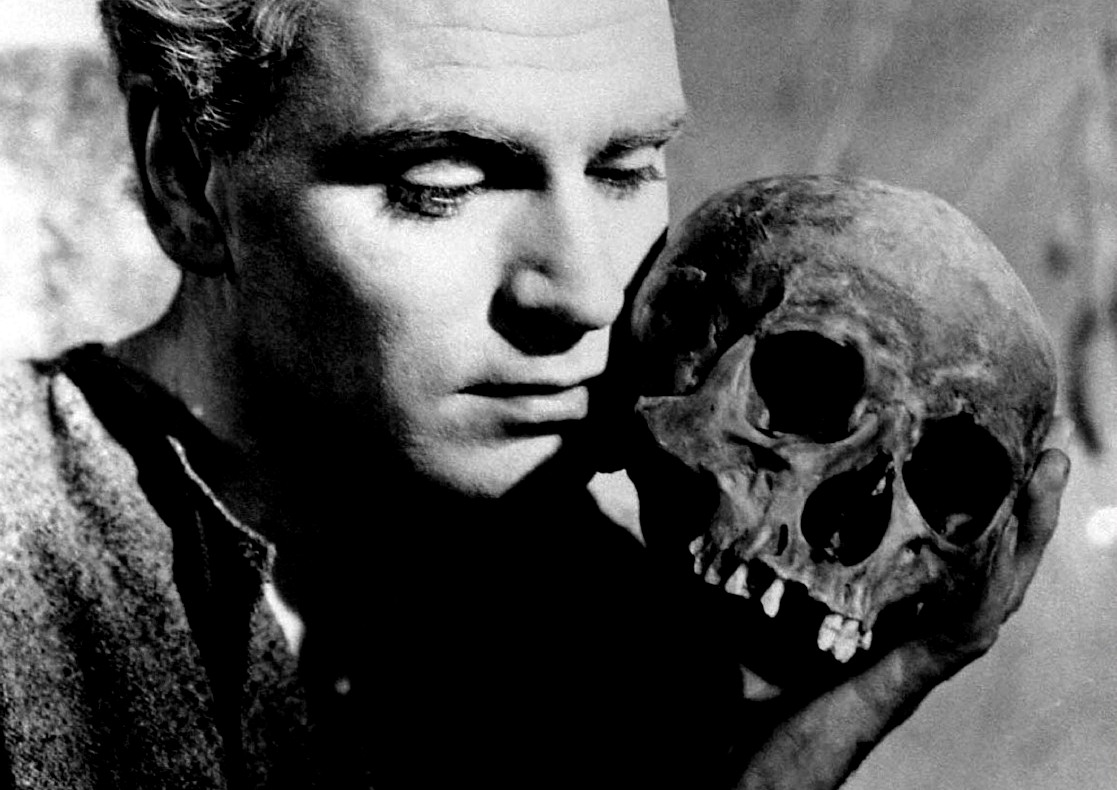
| Laurence Olivier as Hamlet in 1948 |
Here is another link to the text; the 1996 Branagh film is available in three parts at the following links: part one, part two, part three.
(I) Hamlet as Facebook timeline
Click here for the plot of Hamlet as a (very dated!) Facebook News Feed (written by Sarah Schmelling for McSweeneys and Photoshopped by Angela Liao)
(II) Literary Terms
from M. H. Abrams' A Glossary of Literary Terms, 7th ed., 1999:
soliloquy: The act of talking to oneself, whether silently or aloud. In drama it denotes the convention by which a character, alone on the stage, utters his or her thoughts aloud. Playwrights have used this device as a convenient way to convey information about a character's motives and state of mind, or for purposes of exposition, and sometimes in order to guide the judgments and responses of the audience.
from J. A. Cuddon's Penguin Dictionary of Literary Terms and Literary Theory, 4th ed., 1999:
objective correlative: A term first used apparently by the American painter Washington Allston in c. 1840 and subsequently revived and made famous by T. S. Eliot in an essay on Hamlet (1919). The relevant passage is: "The only way of expressing emotion in the form of art is by finding an 'objective correlative'; in other words, a set of objects, a situation, a chain of events which shall be the formula of that particular emotion; such that when the external facts, which must terminate in sensory experience, are given, the emotion is immediately evoked." Eliot goes on to suggest that in Lady Macbeth's sleep-walking speech and in the speech that Macbeth makes when he hears of his wife's death, the words are completely adequate to the state of mind; whereas in Hamlet the prince is "dominated by a state of mind which is inexpressable, because it is in excess of the facts as they appear." These observations have provoked a good deal of debate.
(III) Criticism
(i) J. W. von Goethe (1796):
"The time is out of joint, O cursd spite,
That ever I was born to set it right!
"In these words, I imagine, will be found the key to Hamlet's whole procedure. To me it is clear that Shakespeare meant, in the present case, to represent the effects of a great action laid upon a soul unfit for the performance of it. In this view the whole piece seems to me to be composed. There is an oak-tree planted in a costly jar, which should have borne only pleasant flowers in its bosom; the roots expand, the jar is shivered.
"A lovely, pure, noble and most moral nature, without the strength of nerve which forms a hero, sinks beneath a burden which it cannot bear and must not cast away. All duties are holy for him; the present is too hard. Impossibilities have been required of him; not in themselves impossibilities, but such for him. He winds, and tums, and torments himself; he advances and recoils; is ever put in mind, ever puts himself in mind; at last does all but lose his purpose from his thoughts; yet still without recovering his peace of mind."
(ii) Samuel Taylor Coleridge (1818):
"In Hamlet [Shakespeare] seems to have wished to exemplify the moral necessity of a due balance between our attention to the objects of our senses, and our meditation on the workings of our minds, -- an equilibrium between the real and the imaginary worlds. In Hamlet this balance is disturbed: his thoughts, and the images of his fancy are far more vivid than his actual perceptions, and his very perceptions, instantly passing through the medium of his contemplations, acquire, as they pass, a form and a colour not naturally their own. Hence we see a great, an almost enormous, intellectual activity, and a proportionate aversion to real action consequent upon it, with all its symptoms and accompanying qualities. This character Shakspere places in circumstances, under which it is obliged to act on the spur of the moment: -- Hamlet is brave and careless of death; but he vacillates from sensibility, and procrastinates from thought, and loses the power of action in the energy of resolve. Thus it is that this tragedy presents a direct contrast to that of "Macbeth;" the one proceeds with the utmost slowness, the other with a crowded and breathless rapidity.
"The effect of this overbalance of the imaginative power is beautifully illustrated in the everlasting broodings and superfluous activities of Hamlet's mind, which, unseated from its healthy relation, is constantly occupied with the world within, and abstracted from the world without, giving substance to shadows, and throwing a mist over all common-place actualities. It is the nature of thought to be indefinite; -- definiteness belongs to external imagery alone. Hence it is that the sense of sublimity arises, not from the sight of an outward object, but from the beholder's reflection upon it; -- not from the sensuous impression, but from the imaginative reflex. Few have seen a celebrated waterfall without feeling something akin to disappointment: it is only subsequently that the image comes back full into the mind, and brings with it a train of grand or beautiful associations. Hamlet feels this; his senses are in a state of trance, and he looks upon external things as hieroglyphics. His soliloquy --
"O! that this too too solid flesh would melt," &c.springs from that craving after the indefinite -- for that which is not -- which most easily besets men of genius; and the self-delusion common to this temper of mind is finely exemplified in the character which Hamlet gives of himself: --
"It cannot beHe mistakes the seeing his chains for the breaking them, delays action till action is of no use, and dies the victim of mere circumstance and accident."
But I am pigeon-liver'd, and lack gall
To make oppression bitter."
Coleridge argued that Hamlet's delay "not from cowardice, for he is drawn as one of the bravest of his time – not from want of forethought or slowness of apprehension […] but merely from
that aversion to action, which prevails among such as have a world in themselves."
Coleridge also writes: “all that is amiable and excellent in nature is combined in Hamlet, with the exception of one quality. He is a man living in meditation, called upon to act by every motive human and divine, but the great object of his life is defeated by continually resolving to do, yet doing nothing but resolve.”
(iii) Sigmund Freud, from The Interpretation of Dreams (1899):
“In the Oedipus the child’s wishful fantasy that underlies it is brought out into the open and realized as it would be in a dream. In Hamlet it remains repressed; and – just as in the case of a neurosis – we only learn of its existence from its inhibiting consequences[…]. Hamlet is able to do anything – except take vengeance on the man who did away with his father and took that father’s place with his mother, the man who shows him the repressed wishes of his childhood realized.”
Elsewhere, in a letter, Freud wrote:
“Everyone in the audience was once a budding Oedipus in fantasy, and each recoils in horror from the dream fulfillment here transplanted into reality, with the full quantity of repression which separates his infantile state from his present one.
"Fleetingly the thought passed through my head that the same thing might be at the bottom of Hamlet as well. I am not thinking of Shakespeare’s conscious intentions, but believe, rather, that a real event stimulated the poet to his representation, in that his unconscious understood the unconscious of his hero […]. How does [Hamlet] explain his irresolution in avenging his father? … How better than through the torment roused in him by the obscure memory that he himself had contemplated the same deed against his father out of passion for his mother . . . And is not his sexual alienation in his conversation with Ophelia typically hysterical? . . . And does he not in the end, in the same marvelous way as my hysterical patients do, bring down punishment on himself by suffering the same fate as his father of being poisoned by the same rival?”
(In this context, consider, perhaps, the way Olivier stages the "closet" scene, from 1h28min30s through 1h35m15s here.)
Finally, Freud again from The Interpretation of Dreams:
"The prince in the play, who had to disguise himself as a madman, was behaving just as dreams do in reality; so we can say of dreams what Hamlet says of himself, concealing the true circumstances under a cloak of wit and unintelligibility: 'I am but mad north-by-north-west.'"
(i) Act 1, Scene 2
O that this too too solid flesh would melt,
Thaw, and resolve itself into a dew!
Or that the Everlasting had not fix'd
His canon 'gainst self-slaughter! O God! O God!
How weary, stale, flat, and unprofitable
Seem to me all the uses of this world!
Fie on't! O fie! 'tis an unweeded garden,
That grows to seed; things rank and gross in nature
Possess it merely. That it should come to this!
But two months dead!--nay, not so much, not two:
So excellent a king; that was, to this,
Hyperion to a satyr; so loving to my mother,
That he might not beteem the winds of heaven
Visit her face too roughly. Heaven and earth!
Must I remember? Why, she would hang on him
As if increase of appetite had grown
By what it fed on: and yet, within a month,--
Let me not think on't,--Frailty, thy name is woman!--
A little month; or ere those shoes were old
With which she followed my poor father's body
Like Niobe, all tears;--why she, even she,--
O God! a beast that wants discourse of reason,
Would have mourn'd longer,--married with mine uncle,
My father's brother; but no more like my father
Than I to Hercules: within a month;
Ere yet the salt of most unrighteous tears
Had left the flushing in her galled eyes,
She married:-- O, most wicked speed, to post
With such dexterity to incestuous sheets!
It is not, nor it cannot come to good;
But break my heart,--for I must hold my tongue!
[Enter Horatio, Marcellus, and Bernardo.]
(ii) Act 1, Scene 5
O all you host of heaven! O earth! what else?
And shall I couple hell? O, fie!--Hold, my heart;
And you, my sinews, grow not instant old,
But bear me stiffly up.--Remember thee!
Ay, thou poor ghost, while memory holds a seat
In this distracted globe. Remember thee!
Yea, from the table of my memory
I'll wipe away all trivial fond records,
All saws of books, all forms, all pressures past,
That youth and observation copied there;
And thy commandment all alone shall live
Within the book and volume of my brain,
Unmix'd with baser matter: yes, by heaven!--
O most pernicious woman!
O villain, villain, smiling, damned villain!
My tables,--meet it is I set it down,
That one may smile, and smile, and be a villain;
At least, I am sure, it may be so in Denmark:
[Writing.]
So, uncle, there you are. Now to my word;
It is 'Adieu, adieu! remember me:'
I have sworn't.
(iii) Act 2, Scene 2
Now I am alone.
O, what a rogue and peasant slave am I!
Is it not monstrous that this player here,
But in a fiction, in a dream of passion,
Could force his soul so to his own conceit
That from her working all his visage wan'd;
Tears in his eyes, distraction in's aspect,
A broken voice, and his whole function suiting
With forms to his conceit? And all for nothing!
For Hecuba?
What's Hecuba to him, or he to Hecuba,
That he should weep for her? What would he do,
Had he the motive and the cue for passion
That I have? He would drown the stage with tears
And cleave the general ear with horrid speech;
Make mad the guilty, and appal the free;
Confound the ignorant, and amaze, indeed,
The very faculties of eyes and ears.
Yet I,
A dull and muddy-mettled rascal, peak,
Like John-a-dreams, unpregnant of my cause,
And can say nothing; no, not for a king
Upon whose property and most dear life
A damn'd defeat was made. Am I a coward?
Who calls me villain? breaks my pate across?
Plucks off my beard and blows it in my face?
Tweaks me by the nose? gives me the lie i' the throat
As deep as to the lungs? who does me this, ha?
'Swounds, I should take it: for it cannot be
But I am pigeon-liver'd, and lack gall
To make oppression bitter; or ere this
I should have fatted all the region kites
With this slave's offal: bloody, bawdy villain!
Remorseless, treacherous, lecherous, kindless villain!
O, vengeance!
Why, what an ass am I! This is most brave,
That I, the son of a dear father murder'd,
Prompted to my revenge by heaven and hell,
Must, like a whore, unpack my heart with words
And fall a-cursing like a very drab,
A scullion!
Fie upon't! foh!--About, my brain! I have heard
That guilty creatures, sitting at a play,
Have by the very cunning of the scene
Been struck so to the soul that presently
They have proclaim'd their malefactions;
For murder, though it have no tongue, will speak
With most miraculous organ, I'll have these players
Play something like the murder of my father
Before mine uncle: I'll observe his looks;
I'll tent him to the quick: if he but blench,
I know my course. The spirit that I have seen
May be the devil: and the devil hath power
To assume a pleasing shape; yea, and perhaps
Out of my weakness and my melancholy,--
As he is very potent with such spirits,--
Abuses me to damn me: I'll have grounds
More relative than this.--the play's the thing
Wherein I'll catch the conscience of the king.
(iv) Act 3, Scene 1
Branagh (1996):
Olivier (1948) :
Gibson (1990):
Gibson, for Monsterpiece Theatre:
Stewart, also for Sesame Street:
Hawke (2000):
Tennant (2009):
To be, or not to be,--that is the question:--
Whether 'tis nobler in the mind to suffer
The slings and arrows of outrageous fortune
Or to take arms against a sea of troubles,
And by opposing end them?--To die,--to sleep,--
No more; and by a sleep to say we end
The heartache, and the thousand natural shocks
That flesh is heir to,--'tis a consummation
Devoutly to be wish'd. To die,--to sleep;--
To sleep! perchance to dream:--ay, there's the rub;
For in that sleep of death what dreams may come,
When we have shuffled off this mortal coil,
Must give us pause: there's the respect
That makes calamity of so long life;
For who would bear the whips and scorns of time,
The oppressor's wrong, the proud man's contumely,
The pangs of despis'd love, the law's delay,
The insolence of office, and the spurns
That patient merit of the unworthy takes,
When he himself might his quietus make
With a bare bodkin? who would these fardels bear,
To grunt and sweat under a weary life,
But that the dread of something after death,--
The undiscover'd country, from whose bourn
No traveller returns,--puzzles the will,
And makes us rather bear those ills we have
Than fly to others that we know not of?
Thus conscience does make cowards of us all;
And thus the native hue of resolution
Is sicklied o'er with the pale cast of thought;
And enterprises of great pith and moment,
With this regard, their currents turn awry,
And lose the name of action.--Soft you now!
The fair Ophelia!--Nymph, in thy orisons
Be all my sins remember'd.
(v) Act 3, Scene 2
(please go to 44:15 of this link)
'Tis now the very witching time of night,
When churchyards yawn, and hell itself breathes out
Contagion to this world: now could I drink hot blood,
And do such bitter business as the day
Would quake to look on. Soft! now to my mother.--
O heart, lose not thy nature; let not ever
The soul of Nero enter this firm bosom:
Let me be cruel, not unnatural;
I will speak daggers to her, but use none;
My tongue and soul in this be hypocrites,--
How in my words somever she be shent,
To give them seals never, my soul, consent!
(vi) Act 3, Scene 3
Now might I do it pat, now he is praying;
And now I'll do't;--and so he goes to heaven;
And so am I reveng'd.--that would be scann'd:
A villain kills my father; and for that,
I, his sole son, do this same villain send
To heaven.
O, this is hire and salary, not revenge.
He took my father grossly, full of bread;
With all his crimes broad blown, as flush as May;
And how his audit stands, who knows save heaven?
But in our circumstance and course of thought,
'Tis heavy with him: and am I, then, reveng'd,
To take him in the purging of his soul,
When he is fit and season'd for his passage?
No.
Up, sword, and know thou a more horrid hent:
When he is drunk asleep; or in his rage;
Or in the incestuous pleasure of his bed;
At gaming, swearing; or about some act
That has no relish of salvation in't;--
Then trip him, that his heels may kick at heaven;
And that his soul may be as damn'd and black
As hell, whereto it goes. My mother stays:
This physic but prolongs thy sickly days.
(vii) Act 4, Scene 4
How all occasions do inform against me
And spur my dull revenge! What is a man,
If his chief good and market of his time
Be but to sleep and feed? a beast, no more.
Sure he that made us with such large discourse,
Looking before and after, gave us not
That capability and godlike reason
To fust in us unus'd. Now, whether it be
Bestial oblivion, or some craven scruple
Of thinking too precisely on the event,--
A thought which, quarter'd, hath but one part wisdom
And ever three parts coward,--I do not know
Why yet I live to say 'This thing's to do;'
Sith I have cause, and will, and strength, and means
To do't. Examples, gross as earth, exhort me:
Witness this army, of such mass and charge,
Led by a delicate and tender prince;
Whose spirit, with divine ambition puff'd,
Makes mouths at the invisible event;
Exposing what is mortal and unsure
To all that fortune, death, and danger dare,
Even for an egg-shell. Rightly to be great
Is not to stir without great argument,
But greatly to find quarrel in a straw
When honour's at the stake. How stand I, then,
That have a father kill'd, a mother stain'd,
Excitements of my reason and my blood,
And let all sleep? while, to my shame, I see
The imminent death of twenty thousand men
That, for a fantasy and trick of fame,
Go to their graves like beds; fight for a plot
Whereon the numbers cannot try the cause,
Which is not tomb enough and continent
To hide the slain?--O, from this time forth,
My thoughts be bloody, or be nothing worth!

